Fatigue and Corrosion Assessment for FPSO Life Extension
Ageing FPSOs are a growing share of global production infrastructure. A lot of them were designed for a fixed service life and are now running past their original design basis. Others are sitting idle while somebody decides whether they can be redeployed to a new field. Extend that life without a proper structural and corrosion assessment and you're exposed to hull failure, mooring loss, and regulatory shutdown. Any one of those carries production and safety consequences that dwarf what a structured integrity programme costs.
The question isn't simply whether the hull is corroded or the mooring chains are worn. It's whether the remaining fatigue life and corrosion allowance can be demonstrated to cover the extended operational period with acceptable risk — and whether the inspection programme is actually calibrated to catch deterioration before it becomes a structural event.
Standards and Requirements Context
Most operators start with the ABS Guidance Notes on Life Extension Methodology for Floating Production Installations (ABS, May 2021). That document sets out a tiered assessment methodology covering structural, mooring, and equipment integrity for floating production installations (FPIs). It also says outright what everyone working on converted tankers already knows: original design documents may be incomplete or missing, which makes establishing a baseline harder.
For spectral fatigue analysis of hull structure, the analytical framework comes from the ABS Guidance Notes on Spectral-Based Fatigue Analysis for Floating Offshore Structures. Regulatory oversight requirements for ageing installations are addressed in guidance produced by bodies such as the Petroleum Safety Authority Norway, which commissioned detailed SINTEF research on ageing and life extension methodology.
Where classification societies are involved — as they typically are for continued certification — class rules and the applicable IACS unified requirements for hull surveys and thickness measurement govern the minimum inspection scope.
Hull Fatigue: Screening Before You Commit Resources
Why Fatigue Governs Life Extension Decisions
A converted tanker FPSO accumulates wave-induced cyclic stress at structural discontinuities — bracket toes, web frame cutouts, longitudinal connections at transverse bulkheads — throughout its operational life. The accumulated damage is expressed through Miner's rule:
D = Σ (nᵢ / Nᵢ)
where nᵢ is the number of applied stress cycles at stress range sᵢ, and Nᵢ is the number of cycles to failure at that stress range from the relevant S-N curve. A Miner's sum approaching or exceeding unity signals exhausted fatigue life. For life extension, the question is whether D at the end of the extended period remains below the acceptance criterion in the applicable standard.
The ABS spectral fatigue guidance uses long-term stress range distributions derived from wave scatter diagrams for the specific field location. Here's the part that catches people out: a unit redeployed from a benign environment to a harsher metocean regime accumulates fatigue damage at a materially higher rate than its original design assumed. That is one reason relocation assessments must re-run the fatigue analysis for the new site. You can't just transfer the original results and call it done.
Screening Methodology
The ABS 2021 life extension guidance recommends a tiered screening approach:
- Level 1 — Desk-based screening: Pull the original fatigue analysis reports. Identify structural details with remaining fatigue life (RFL) shorter than the projected extension period and flag them for further assessment. If no original analysis exists, a simplified deterministic fatigue calculation using the governing S-N curve and an assumed stress concentration factor gives you a conservative first filter.
- Level 2 — Refined spectral analysis: For details that fail Level 1 screening, run a full spectral-based fatigue analysis using site-specific wave data and a validated hydrodynamic model. This resolves whether the Level 1 conservatism was masking adequate life or confirming a genuine deficit.
- Level 3 — Fitness-for-service and fracture mechanics: Where cracks are found or RFL is exhausted, fracture mechanics assessment (following established methodologies such as those in
BS 7910) determines whether the detail can continue in service with enhanced monitoring or requires repair.
Corrosion Assessment: Beyond Thickness Measurement
Structural Corrosion
Hull corrosion in FPSOs shows up in ballast tanks, void spaces, and cargo tanks — anywhere coating breakdown exposes steel to seawater or hydrocarbon-laden vapour. The standard metric is measured plate thickness against original scantling, with wastage assessed against class-accepted diminution limits.
Thickness measurement alone won't carry a life extension case, though. Distribution matters. Localised pitting sitting on a stress concentration is structurally more significant than uniform general corrosion of the same average depth. A structured close-up survey, using ultrasonic thickness measurement on a grid pattern defined by the risk-based inspection (RBI) plan, captures both average diminution and peak local loss.
Coating condition directly governs the rate of future wastage. Record it as a category, not merely note that coating is "degraded." A tank with widespread coating breakdown and no cathodic protection backup will corrode at a substantially higher rate than one with intact coating, and the life extension projection must account for this.
Mooring Chain Wear and Corrosion
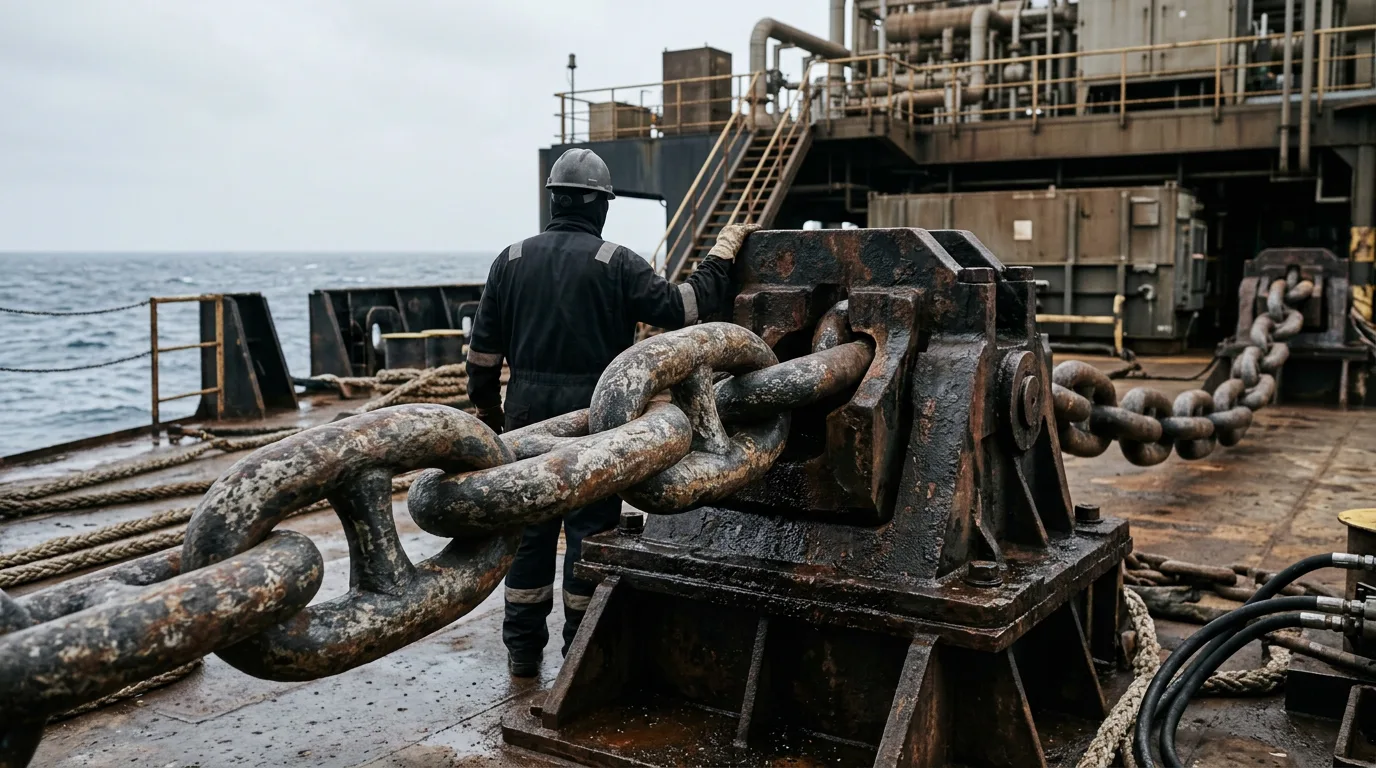
Mooring chain integrity is a distinct failure mode from hull fatigue, but it's equally life-limiting. Wear occurs at the interlink contact points. Corrosion reduces cross-sectional area. The combination degrades both the static break load and the fatigue capacity of the chain.
Chain inspection requires retrieval or ROV survey with dimensional measurement. Diameter reduction is compared against original nominal diameter; the applicable standard (typically the relevant DNV or ABS mooring standard) sets the acceptance criterion. Where chains cannot be retrieved, in-situ ROV measurement with calibrated tooling provides the dimensional data needed for a fitness-for-service judgement.
Risk-Based Inspection Planning
Structuring the RBI Framework
RBI for FPSO life extension pushes inspection resource toward locations where the combination of failure likelihood and consequence is highest. The ABS 2021 guidance explicitly supports an RBI approach as the basis for developing the enhanced survey programme required for life extension certification.
The framework requires:
- A degradation mechanism register for each structural zone (fatigue, general corrosion, pitting, erosion-corrosion at nozzles)
- A consequence assessment distinguishing structural collapse, flooding, hydrocarbon release, and loss of station-keeping
- A likelihood assessment drawing on remaining fatigue life calculations, coating condition, corrosion history, and inspection findings
The output is a ranked list of inspection items, with frequency and method specified for each. High-consequence, high-likelihood items — a bracket toe with low RFL in a flooded ballast tank with failed coating, say — receive close-up survey and thickness measurement at each scheduled drydock or in-water survey. Lower-risk items may be covered by general examination.
Comparison of Inspection Approaches
| Inspection Method | Applicable Degradation | Key Limitation |
|---|---|---|
| Ultrasonic thickness (grid) | General and pitting corrosion | Misses tight fatigue cracks |
| Magnetic particle inspection | Surface-breaking fatigue cracks | Requires surface preparation and access |
| Eddy current testing | Near-surface cracking under coating | Coating thickness affects sensitivity |
| ROV visual + dimensional | Mooring chain wear, external corrosion | Cannot assess internal chain condition |
| Fracture mechanics (BS 7910) | Crack fitness-for-service | Requires accurate crack dimensions as input |
Illustrative Scenario
The following scenario is illustrative and does not represent a specific named project.
An operator evaluates a converted tanker FPSO for a service life extension. The original fatigue analysis, completed for a West African location, shows Miner's sums below the acceptance threshold for all primary structural details. The proposed extension would redeploy the unit to a North Sea field with a significantly more severe wave environment.
Level 1 screening against the new site's wave scatter diagram identifies several bracket toes at transverse web frames where the projected Miner's sum at end of extended life exceeds the acceptance criterion. Those details proceed to Level 2 spectral analysis. The refined analysis confirms that two locations remain non-compliant. A Level 3 fracture mechanics assessment then demonstrates that, with a defined inspection interval using magnetic particle inspection and a commitment to repair on detection of any crack exceeding a defined size, the details can be accepted for the extended period under a documented fitness-for-service case.
At the same time, mooring chain ROV survey finds diameter reduction at several interlinks in the splash zone. Measured values are compared against the acceptance criterion in the applicable mooring standard; one chain leg falls below the minimum and is scheduled for replacement before the extension period commences.
Life Extension Assessment Checklist
- Establish whether original design documentation — fatigue analysis, corrosion allowance basis, mooring design report — is available and complete.
- Confirm the metocean data used in original fatigue analysis matches the proposed extension site; commission new spectral analysis if the environment differs materially.
- Screen all structural details using Miner's rule against the extended operational period; escalate details with insufficient RFL to Level 2 or Level 3 assessment.
- Conduct close-up survey of all ballast tanks and cargo tanks; record coating condition category and thickness diminution on a defined grid.
- Assess pitting depth and distribution at stress concentrations separately from average plate wastage.
- Survey mooring chains for diameter reduction and corrosion pitting; compare against applicable acceptance criteria and replace non-compliant legs before extension commences.
- Develop an RBI plan that ranks structural zones by degradation likelihood and consequence; define inspection method, frequency, and acceptance criteria for each zone.
- Document all findings, residual life calculations, and acceptance cases in a life extension dossier acceptable to the relevant classification society and regulatory authority.
- Establish a monitoring and anomaly management protocol: any in-service finding that deviates from the RBI baseline triggers re-assessment of the affected zone.
Conclusion
FPSO life extension is an engineering decision, not a commercial one. Hull fatigue screening with a tiered spectral analysis approach, corrosion assessment that captures coating condition and pitting distribution rather than average wastage alone, and mooring chain dimensional survey — that is the technical foundation. An RBI plan built on it keeps inspection effort concentrated where failure consequences are greatest.
The immediate next step for any operator considering extension is to audit the completeness of original design documentation. Where gaps exist — missing fatigue analysis, undocumented structural modifications, absent mooring design records — those gaps define the scope of the baseline assessment that must be completed before any life extension period can be justified to a classification society or regulator. The ABS 2021 life extension guidance provides a structured methodology for that process and is the appropriate starting point for the integrity team.