Hurricane-exposed platforms have a planning problem that a conventional emergency shutdown (ESD) philosophy does not fully cover. ESD logic is built for fast events: a gas release, a fire, a loss of containment. A hurricane is slow and forecastable, but it takes your options away one at a time. Helicopters stop flying. Vessels cannot come alongside. Marine and power systems degrade. If shut-in, demanning and securing the facility are not sequenced against that closing window, you end up with one of two bad outcomes: an unplanned emergency shutdown in deteriorating weather, or people on board when no safe way off remains. Both carry safety, asset and environmental consequences, and restarting after an uncontrolled shutdown is slower and riskier than restarting after a planned one.
This article separates the shutdown tiers, explains where the temporary refuge (TR) fits into a hurricane strategy, and sets out how to build an evacuation timing study that decision-makers can rely on.
Standards and Regulatory Context
The following are the anchors I would use:
IEC 61511covers functional safety for safety instrumented systems in the process industry. It governs how shutdown functions are specified, verified and maintained when they are implemented as safety instrumented functions.API RP 14Ccovers analysis, design, installation and testing of basic surface safety systems for offshore production platforms. It is the traditional basis for process shutdown and safety device logic on US-regulated installations.ISO 13702covers control and mitigation of fires and explosions on offshore production installations. It is the common reference for ESD philosophy, TR functions and escape and evacuation provisions.
Regulators put the responsibility on the operator. BSEE's hurricane guidance says the operator must develop and implement emergency response plans that include provisions for evacuating personnel, and must assess hurricane risks and act on them, including fire and explosion analysis and evacuation. The Oil & Gas UK (now OEUK) Industry Guidelines for the Management of Emergency Response for Offshore Installations, Issue 3 (2010), is still a useful reference for structuring command, control and emergency response competence. Neither document is specific to hurricanes, but both expect evacuation to be analysed, not assumed.
ESD Hierarchy: Emergency Versus Precautionary Shutdown
Keep two shutdown modes distinct
Hurricane preparation involves two different modes, and mixing them up causes trouble.
- Emergency shutdown is initiated automatically or by hand in response to a hazardous event. It is fast, it prioritises isolation, and it is designed to fail to a defined safe state.
- Precautionary (planned) shutdown is a staged, operator-led sequence triggered by a forecast. It is slower and controlled. Wells are shut in, process inventory is managed, and the facility is left in a state that can ride out the storm unmanned.
The planned sequence should use the same final isolation devices as the ESD, but it should not depend on the ESD to carry it out.
Typical hierarchy and what it must protect
Operators name their levels differently, so define yours explicitly in the philosophy document. The functional structure is generally as follows.
| Tier | Typical function | Hurricane relevance |
|---|---|---|
| Unit or equipment shutdown | Isolates a single item or train | Used during staged shut-in to take trains offline in order |
| Process or area shutdown | Shuts down and isolates the process, depressurises as designed | Core of the precautionary sequence and of ESD on a hazardous event |
| Platform ESD | Isolates all hydrocarbon sources, including riser and wellhead valves, and shuts down non-essential electrical loads | Final secured state before the facility is left |
| Abandonment-level shutdown | Platform ESD plus initiation of abandonment alarms and systems | Rarely a hurricane trigger, but it must remain available while anyone is on board |
Define the safe state per function
A common ESD design error is assuming "de-energise to trip" is right for every function. It isn't. The safe state has to be defined for each function through hazard analysis, not assumed. A valve may need to stay open to prevent overheating. Emergency lighting, fire detection, communications and evacuation systems have to keep running after production equipment shuts down. In a hurricane context, that means:
- keeping fire and gas detection, public address and emergency power alive after production is isolated, while personnel remain on board;
- confirming what happens to utility and instrument air when main power is lost in a storm;
- deciding whether flare and vent systems must stay available during a long unmanned period.
Dynamically positioned units
For DP vessels and MODUs, ESD must not be allowed to cause a loss of position. In hurricane season this matters a great deal, because a blackout in heavy weather creates a second emergency. Decisions about disconnecting or staying should follow a pre-agreed plan, not an ad hoc call, and that is the right model for any operator. Agree written decision points, owners and triggers before the season begins.
Temporary Refuge Design in a Hurricane Context
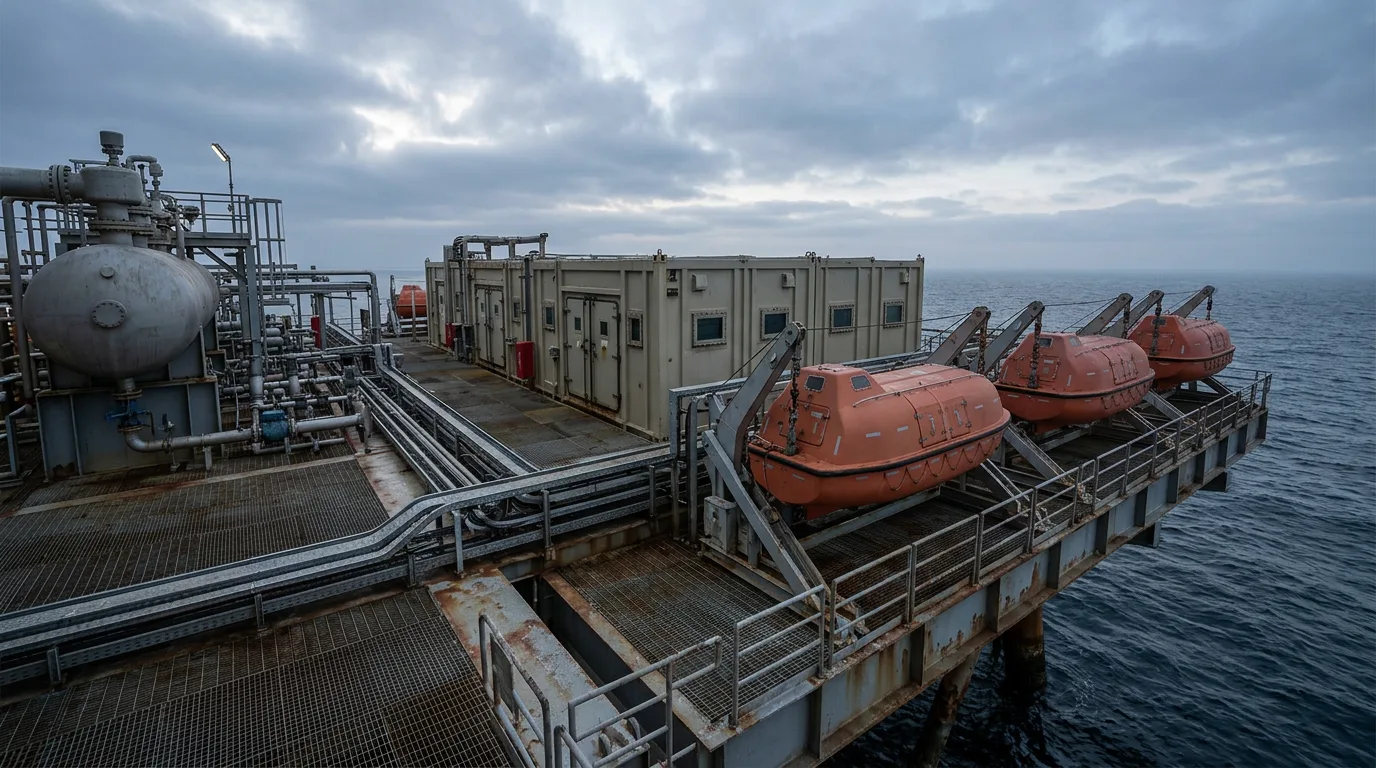
The TR protects personnel from fire, explosion, and smoke or toxic gas for as long as it takes to complete emergency response and evacuation, as framed in ISO 13702. It is not normally a hurricane shelter, and treating it as one is a strategic error. A manned-through-the-storm approach would need its own structural, motion, life support and escape analysis, and most TR designs were never meant to meet that standard.
Where the strategy is to deman the installation before landfall, the TR still matters in two ways:
- Final-stage demanning. The last people on board work from the TR, and its communications, muster control and detection have to work until the last departure.
- Residual risk if evacuation is interrupted. If a helicopter or vessel is lost or delayed, the people left on board need a defensible place to be. The study should say explicitly whether the TR is acceptable for that case, and for how long. Leaving the question open is not an option.
For design review, check TR survivability against hazards that coincide with severe weather: loss of main power, escape routes blocked by wind and wave action on exposed walkways, and degraded HVAC dampers or intakes. Also confirm that lifeboat and liferaft launch areas are usable in the forecast sea state, because evacuation by sea is usually the last resort.
Evacuation Timing Studies
Build the timeline backward from weather
An evacuation timing study answers one question. From the moment a decision is taken, can everyone get safely off the installation before the weather shuts down the means of leaving? The answer has to be expressed as a margin.
The required time is the sum of sequential elements:
T_required = T_decision + T_shut-in + T_mobilise + T_embark + T_transit_and_recovery
and the margin is:
Margin = T_available − T_required
T_available is the time from the decision point to the forecast onset of conditions that stop the chosen evacuation modes (aircraft operations, vessel alongside operations, launch of survival craft). Each term needs an owner and a basis: historic drill data, contractor commitments, or simulation.
Three points keep the study honest:
- Parallel versus serial. Shut-in, securing of cranes and loose items, and personnel movement overlap in practice, but only where manning and permits allow it. Model the real dependencies.
- Mode failure. Test the case where the primary mode is unavailable, such as a grounded aircraft fleet or a late vessel, and see what the margin becomes.
- Forecast uncertainty. T_available comes from a track and intensity forecast that keeps changing. Set the decision trigger early enough that the margin survives a pessimistic forecast, not just the central one.
Modelling and optimisation
The OTC paper "Evacuation Procedure Modeling and Optimization for Offshore Structures" (2022) addresses disconnectable FPSOs in hurricane and cyclone regions, where the evacuation procedure has to be modelled as a whole. What a practitioner gets from it is the approach: treat the procedure as a model whose steps can be sequenced, tested and optimised, rather than as a static checklist. Disconnectable systems add steps such as disconnection and vessel departure. Those steps belong in the timeline and in the ESD logic that supports them.
Illustrative Scenario
The following is a constructed illustration, not a reported event.
A fixed production platform in a hurricane-prone basin uses helicopters as its primary evacuation mode and a standby vessel as the secondary. The operations team runs a timing review when a storm enters the planning cone.
- The team lists each timeline element and assigns an owner: decision authority, production shut-in, subsea and wellhead isolation, deck securing, helicopter mobilisation, passenger processing and final departure.
- Production shut-in turns out to be the longest single element, because several trains have to come offline in sequence and the gas compression train needs a controlled depressurisation. The review therefore starts shut-in earlier than demanning, so the two overlap.
- The helicopter provider reports that its aircraft cannot operate once conditions pass a company limit. The team uses the forecast arrival time of those conditions as T_available for the primary mode.
- Margin = T_available − T_required for the central forecast comes out positive. Repeating the calculation with an earlier-arriving forecast and one aircraft unavailable gives a negative margin.
- The platform therefore sets its decision trigger earlier, and the checklist gains a requirement to confirm vessel availability whenever the aircraft margin is thin.
The second calculation is the point of the exercise. A single positive margin on the best-case forecast is not an acceptable basis for a decision.
Practical Checklist
Philosophy and logic
- Define precautionary shutdown and emergency shutdown as separate documented modes, with a clear boundary between them.
- Confirm that the cause-and-effect charts show the safe state per function, with the hazard analysis behind each one.
- Verify that emergency power, detection, communications and muster systems stay available after process isolation while anyone is on board.
- For DP units, review ESD actions against loss-of-position consequences.
Temporary refuge and escape
- State the TR's design basis and whether it is accepted as a refuge if evacuation is interrupted.
- Check escape routes, embarkation points and launch areas for usability in the forecast weather.
- Confirm HVAC, intake and damper behaviour on loss of main power.
Evacuation timing
- Document every timeline element with an owner and a basis.
- Calculate the margin for the central forecast, a pessimistic forecast, and a degraded evacuation mode.
- Set decision triggers from the pessimistic case, and name the person with authority to invoke them.
- Align contractor commitments (aircraft, vessels, shore reception) with the study assumptions in writing.
Restart and review
- Plan how the facility is left: valve positions, inventory, secured equipment and monitoring of the unmanned installation.
- Develop a post-storm inspection and re-entry procedure before the season begins. Any work that opens or inspects hydrocarbon-containing equipment on re-entry must follow isolation, depressurisation, verification of zero energy, lock-out/tag-out, hazardous-area precautions, gas detection and safe venting.
- Run a drill of the full timeline, and update the study with what the drill revealed.
Conclusion
A hurricane strategy rests on three things working together: an ESD philosophy that separates planned from emergency shutdown, a TR whose role is defined honestly, and an evacuation timing study that expresses the answer as a margin under pessimistic conditions. Start by reviewing your current philosophy for the precautionary-versus-emergency boundary and the per-function safe states. Then rebuild the evacuation timeline backward from the weather, and test it with a degraded evacuation mode. Where gaps turn up, close them before the season, using IEC 61511, API RP 14C and ISO 13702 as the technical frame and your regulator's emergency planning expectations as the compliance frame.