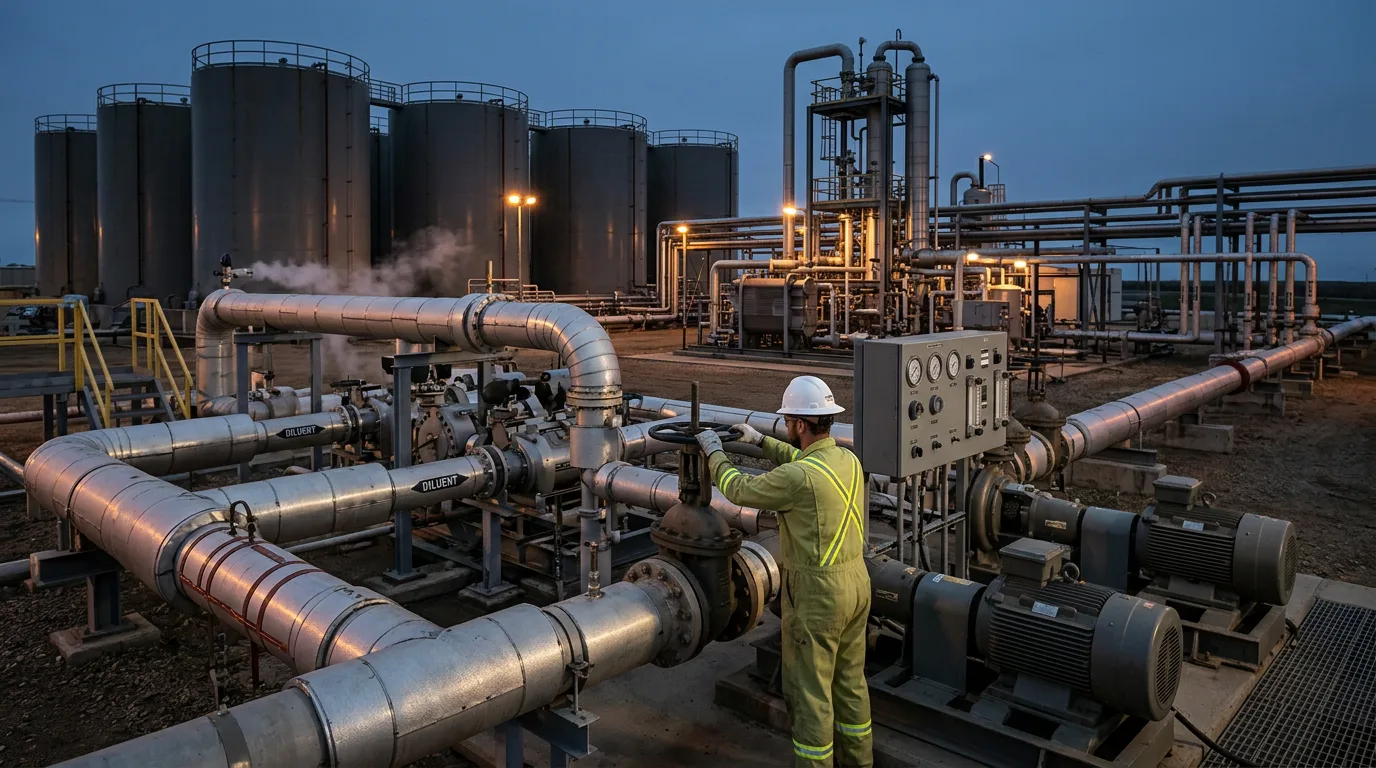
Diluent Blending for Heavy Crude Pipeline Transport: Solvent Selection, Blending Ratios, and Restart Design
Moving heavy crude oil and bitumen through long-distance pipelines is not a viscosity problem in isolation. It is a logistics, cost, and reliability problem, and the penalties stack up at every stage of the value chain. When a pipeline carrying diluted bitumen (dilbit) shuts down unexpectedly, the blend in the line starts to segregate and cool. Restart forces climb. Pumps cavitate or stall. In cold climates, the window between a controlled shutdown and a stuck line narrows faster than many operators plan for. Getting diluent selection, blending ratio, and restart procedure right from the start is not an optimisation exercise. It is a prerequisite for operability.
Why Heavy Crude Requires Dilution
Bitumen at reservoir conditions, and even at surface temperatures, behaves closer to a solid than a liquid. At room temperature, bitumen viscosity can exceed one million centipoise — orders of magnitude above the threshold at which conventional centrifugal pumps can develop useful head.
The goal of diluent blending is to reduce blend viscosity to a level that allows economical pipeline transport: sufficient pump suction head, manageable pressure drop per unit length, and a blend that will restart after a planned or unplanned shutdown. Those three requirements do not always point to the same diluent choice or the same blending ratio. That is where engineering judgment becomes essential.
Diluent Options and Solvent Selection
Condensate and Natural Gas Liquids
Field condensate — a mixture of light hydrocarbons recovered from gas processing — is the most widely used diluent in Canadian oil sands operations and in heavy crude regions globally. The Enbridge pipeline system, for example, has transported condensate-based diluents as part of its liquid petroleum products portfolio for many years. Condensate is attractive because it is produced locally in many hydrocarbon basins, its handling infrastructure is already in place, and its aromatic and naphthenic fractions interact favorably with the asphaltene fraction of heavy crude, reducing the risk of asphaltene precipitation.
Naphtha
Naphtha offers viscosity reduction efficiency comparable to condensate. Experimental work on Iranian heavy crude oil (12.71° API range) published in peer-reviewed literature confirms that naphtha achieves meaningful viscosity reduction across a range of blending ratios. However, naphtha's lighter end components increase vapor pressure of the blend, which has implications for pump inlet design and tank breathing losses.
Heptane and Toluene
Laboratory studies comparing heptane, methanol, toluene, gas condensate, and naphtha as diluents for heavy crude have evaluated their relative efficiency. Aromatic solvents such as toluene show promise for viscosity reduction, though the optimal volume fraction depends on the crude composition and operating conditions. However, toluene is more expensive, has a lower threshold limit value for occupational exposure, and introduces additional regulatory classification requirements. It is rarely used as a primary pipeline diluent but remains relevant as a reference fluid in flow assurance modeling.
Methanol
Methanol achieves limited viscosity reduction relative to hydrocarbon solvents at comparable volume fractions and introduces water-phase miscibility concerns. It is not a practical primary diluent for pipeline transport of heavy crude.
Diluent Selection Summary
| Diluent | Viscosity Reduction Efficiency | Asphaltene Stability | Vapor Pressure Concern | Typical Availability |
|---|---|---|---|---|
| Condensate | High | Generally favorable | Moderate | High in producing basins |
| Naphtha | High | Moderate | Moderate–High | Refinery-dependent |
| Heptane | Moderate–High | Lower (paraffinic) | Low–Moderate | Limited at scale |
| Toluene | High at low volume fraction | High | Low | Limited, costly |
| Methanol | Low | Poor | Low | Widely available, impractical |
Qualitative ratings only; no numeric thresholds attributed without source.
Blending Ratios and Viscosity Reduction Mechanics
The relationship between diluent volume fraction and blend viscosity is nonlinear. Small initial additions of diluent produce disproportionately large viscosity reductions; further additions yield diminishing returns. This behavior is well documented in the IFP Energies nouvelles heavy oil dilution literature (Gateau, Hénaut, Barré, 2004) and in the 2024 techno-economic study of distillate and crude oil diluents published in Industrial & Engineering Chemistry Research.
A 2024 study of distillate and crude oil diluents evaluated multiple distillate fractions, confirming that the choice of diluent cut — not just its volume fraction — materially affects both viscosity outcome and transport economics. [Author and full journal citation required; see declared sources for verification.] Lighter distillate cuts achieve lower blend viscosity at a given volume fraction but increase vapor pressure and reduce the energy content of the transported stream.
Practically, the blending ratio is constrained by:
- Pipeline inlet viscosity specification: Most long-haul heavy crude pipelines specify a maximum blend viscosity at the pump inlet temperature. The ratio must be sufficient to meet this limit under the coldest expected operating temperature.
- Diluent availability and logistics: Diluent must be transported back to the production end of the system after separation at the terminal — the so-called "diluent return" problem. Every additional volume percentage of diluent consumed per barrel of bitumen transported represents a round-trip logistics cost and a capacity penalty on the mainline.
- Asphaltene precipitation threshold: Paraffinic diluents added beyond a critical concentration can destabilize asphaltenes, causing deposition in the line. The critical threshold depends on the crude's asphaltene content and the diluent's aromaticity. Blending above this threshold without inhibitor treatment creates a fouling risk that is difficult and costly to remediate.
Restart Design for Diluted Bitumen Lines
The Restart Problem
When a dilbit pipeline shuts down — whether for a planned maintenance window or an unplanned trip — the blend in the line begins to lose heat to the surrounding soil or seabed. As temperature drops, viscosity rises, and the pressure required to restart flow increases. If the line cools below the pour point of the blend, or if the diluent and heavy crude fractions begin to segregate in low-lying sections, restart may require pressures that exceed the pipeline's maximum allowable operating pressure (MAOP).
Flow assurance analysis of heavy crude pipelines identifies restart force and viscosity-driven pressure rise as critical design constraints, particularly in systems that lack active thermal management. For dilbit specifically, the concern is less about true gelation — which is a wax-driven phenomenon more common in waxy crude — and more about the steep viscosity-temperature relationship of the asphaltenic heavy crude fraction.
Design Measures for Reliable Restart
Minimum diluent ratio floor: The blending ratio should be set not only to meet steady-state viscosity specifications, but to ensure that the blend viscosity at the minimum expected shutdown temperature remains within the restart capability of the installed pump train. This requires a cold-restart hydraulic model, not just a steady-state flow model.
Thermal insulation and burial depth: Burial depth affects the rate of heat loss during shutdown. In permafrost or cold-climate installations, insulation or active heating may be required to maintain the blend above a minimum restart temperature for a defined soak period. The length of that soak period should be defined by the cold-restart hydraulic analysis, not assumed.
Pig-assisted restart: For long lines where full-line pressurization during cold restart is hydraulically marginal, a pig train ahead of the restart slug can reduce the column of fluid that must be moved simultaneously and allows pressure to build progressively.
Pump sequencing: Restart sequencing should be defined in the operating procedure. Starting all pumps simultaneously against a cold, high-viscosity line risks motor overloads and check valve hammering. Staged startup — beginning with the downstream pump station and working upstream — reduces peak startup torque.
Diluent injection point location: Injecting diluent as close as possible to the heavy crude source minimizes the length of undiluted heavy crude in the gathering system and reduces the risk of cold plugging upstream of the mainline inlet.
Illustrative Scenario
The following is illustrative and not drawn from a named project or incident.
Consider a heavy crude producer blending a 12° API crude with field condensate for transport on a trunk line. The steady-state blend ratio is set to meet the pipeline's viscosity specification at normal operating temperature. An unplanned compressor shutdown at the gas plant reduces condensate availability, and field operators reduce the diluent injection rate to maintain throughput. The blend entering the line becomes progressively heavier. Overnight, ambient temperature drops. By the time the line is shut down for a pressure survey, the blend viscosity in the coldest section of the line has risen well above the design restart envelope. Restart the following morning requires multiple attempts and causes a pump motor trip on overload. The resolution — slow warm-up of the line section using a reduced-rate circulation loop — takes several hours and delays nominations.
The root cause is not the shutdown itself but the absence of a minimum diluent ratio interlock tied to condensate supply pressure, and the absence of a cold-restart viscosity check in the operating procedure.
Practical Checklist: Diluent Blending and Restart Readiness
Solvent Selection
- [ ] Confirm diluent aromaticity is sufficient to maintain asphaltene stability at the maximum planned blending ratio
- [ ] Verify vapor pressure of the blend at maximum operating temperature against pump inlet design pressure
- [ ] Assess diluent return logistics capacity — diluent demand must be supportable round-trip
Blending Ratio
- [ ] Set steady-state ratio to meet pipeline viscosity specification at minimum operating temperature, not average temperature
- [ ] Run a cold-restart hydraulic model at minimum expected shutdown temperature and maximum planned soak duration
- [ ] Define a minimum ratio floor and install an interlock or alarm on diluent injection rate
Restart Design
- [ ] Document pump startup sequence for cold restart in the operating procedure
- [ ] Define the maximum soak duration after which a warm-up or pigging procedure is required before restart
- [ ] Confirm MAOP is not exceeded during cold restart at maximum calculated viscosity
- [ ] Verify check valve and control valve actuator torque ratings against cold-restart differential pressure
Safety — Line Entry and Sampling Any procedure requiring line opening, sampling, or inspection of diluent injection equipment must follow full isolation and lockout/tagout (LOTO) procedures: positive isolation of all hydrocarbon sources, depressurization and verification of zero pressure, verification of zero energy state, continuous gas detection in the work area, and safe venting to an approved flare or vapor recovery system. Condensate and naphtha vapors are heavier than air and will accumulate in low points; hazardous-area classifications must be observed.
Conclusion
Diluent blending is not a set-and-forget operation. The solvent selected, the ratio maintained, and the restart procedure designed must be treated as an integrated system. Condensate and naphtha remain the practical choices for most heavy crude pipelines, but the blending ratio must be validated against cold-restart hydraulics — not just steady-state flow. Operators working under tight diluent logistics should establish minimum ratio interlocks and maintain a current cold-restart hydraulic model updated for seasonal temperature variation.
The next step for any team reviewing an existing heavy crude pipeline operation is straightforward: run a cold-restart simulation at your minimum recorded soil or ambient temperature with your current diluent ratio, compare the required restart pressure against your MAOP, and close the gap before winter operating conditions arrive.