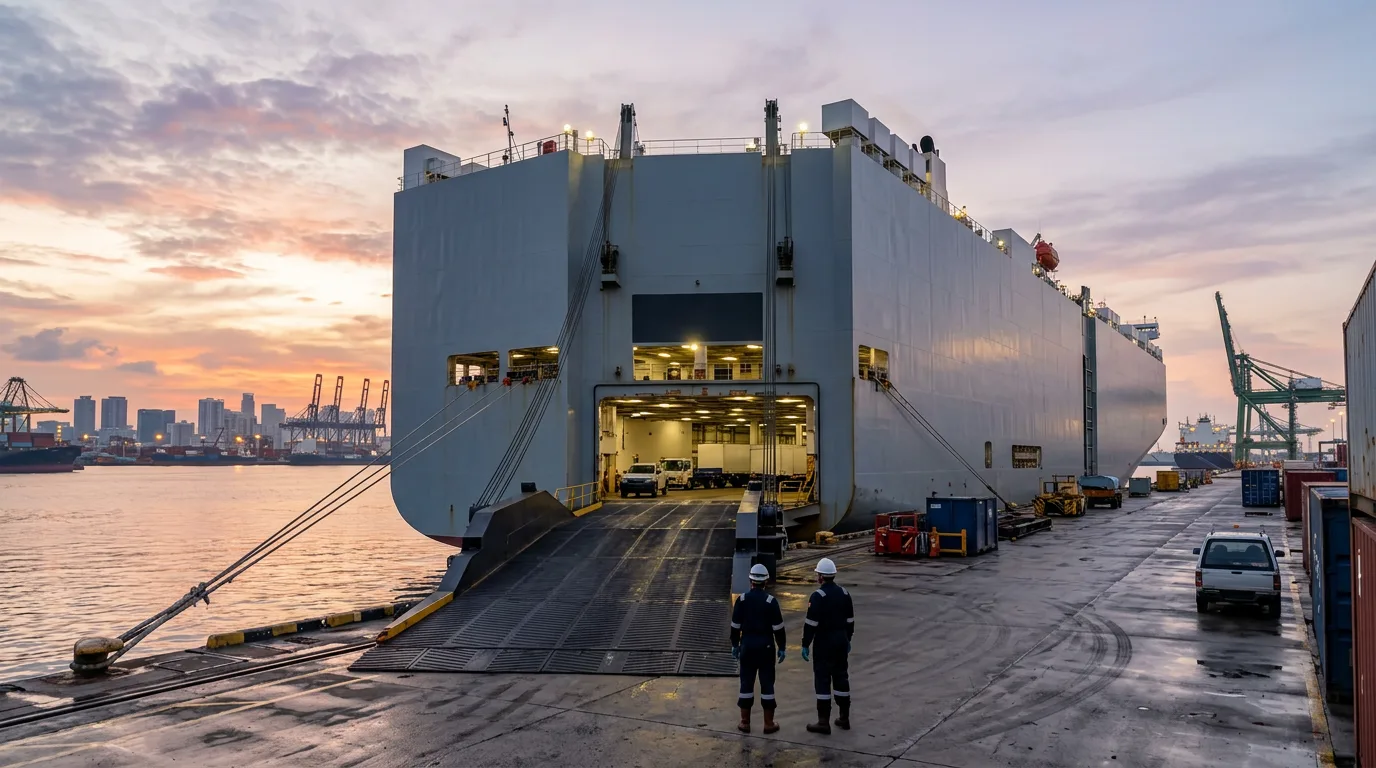
Singapore Shipping has ordered two pure car and truck carriers that will be built in China. The contract has been placed with Guangzhou Shipyard International, and the vessels are specified as LNG dual-fuel. Further details, such as carrying capacity, delivery timing and contract value, were not immediately available.
Dual-fuel propulsion allows a ship's engines to run on liquefied natural gas or on conventional oil-based marine fuel, with the crew able to switch between the two. In practice, that lets the operator take LNG where bunkering supply is available and fall back on conventional fuel where it is not, without being tied to a single fuel. LNG contains virtually no sulphur and produces fewer particulates than residual fuel oils, which is central to its case as a marine fuel.
Pure car and truck carriers are specialized vessels designed to move vehicles in volume, with multiple decks configured for cars and trucks to be driven aboard and secured for the voyage. Their schedules are typically set by vehicle production and delivery flows between manufacturing regions and end markets. For tonnage of this type, the ability to choose between gas and conventional fuel at each port call is an operational consideration as much as an environmental one.
For the oil and gas industry, each LNG dual-fuel newbuild represents potential future demand for LNG bunkering, since the gas capability only pays off where supply infrastructure exists along a ship's trading routes. The contract also links a Chinese shipyard with LNG-fuelled tonnage in the car carrier segment. How much of the dual-fuel capability the two ships actually use will depend on where they trade and on how LNG bunkering develops at the ports they serve.
Source: LNG Prime