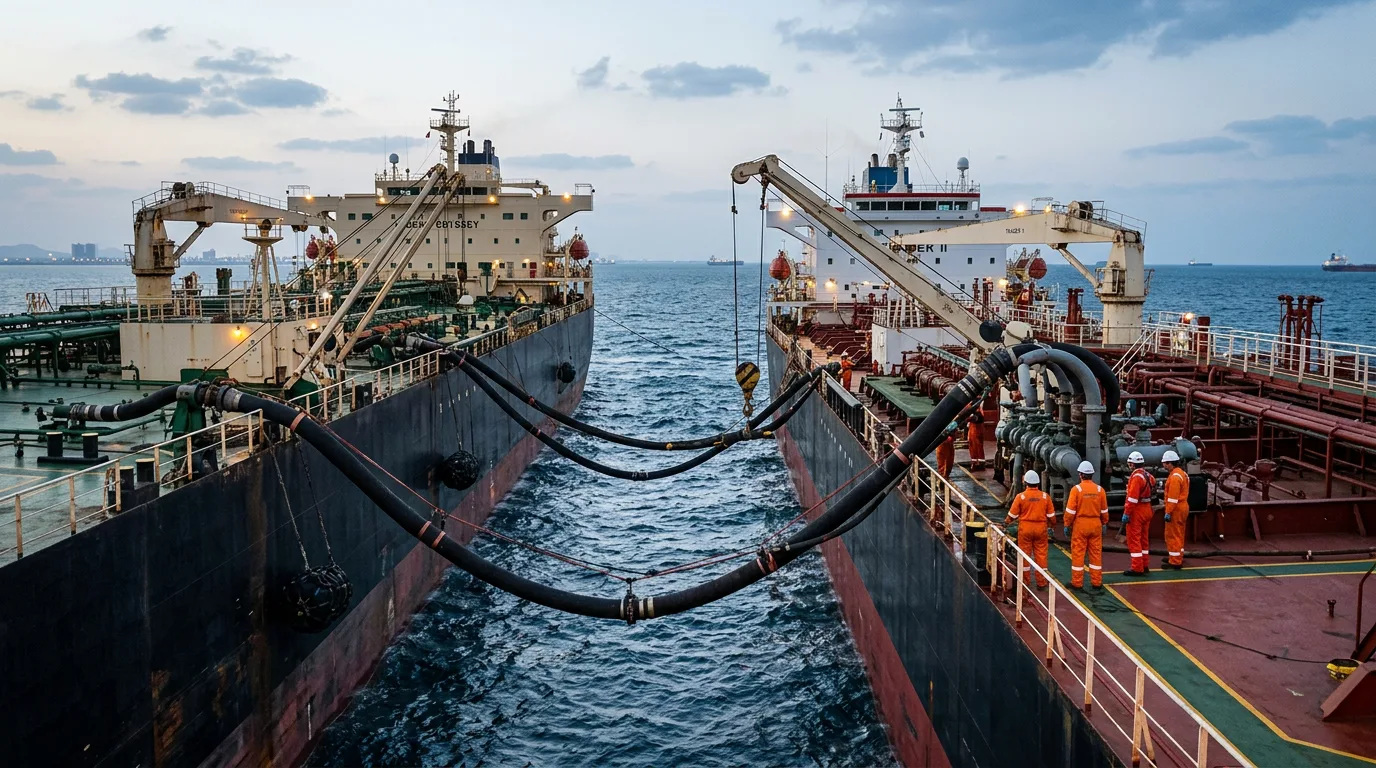
Russell Hardy, chief executive officer of Vitol Group, the world's biggest independent oil trader, has warned that ship-to-ship (STS) transfers in the Gulf of Oman are critical to keeping oil flowing from the Middle East. Speaking at the Energy Intelligence Forum in London this week, Hardy described the transfers as a lifeline both to Gulf producers and to the wider oil market.
Hardy's warning was direct: if the STS operations were to stop, a $200-a-barrel scenario would come into play. "Without it, you do have that $200-a-barrel scenario, so it is pretty important it continues," he said. His remarks underline how dependent the movement of crude from the region has become on these offshore transfers, which allow cargoes to be combined or split between vessels at sea rather than relying solely on terminal infrastructure.
The Vitol chief also pointed to the state of inventories as a reason the market has little cushion against disruption. "There aren't any more inventories to drain in the West," Hardy noted, suggesting that stocks held in Western markets can no longer be drawn down to offset supply shortfalls. In his view, that leaves the physical flow of Middle Eastern barrels — and the STS operations that support it — as a key pillar of global supply.
For traders, producers and end users, the comments from the head of the largest independent crude trader highlight the narrow margin between current market conditions and a sharply higher price environment. With inventories depleted and Gulf exports reliant on continued STS activity, any interruption to those transfers would, in Hardy's assessment, put oil on a path toward $200 a barrel.
Source: Oilprice