The cost of leaving water in a gas line
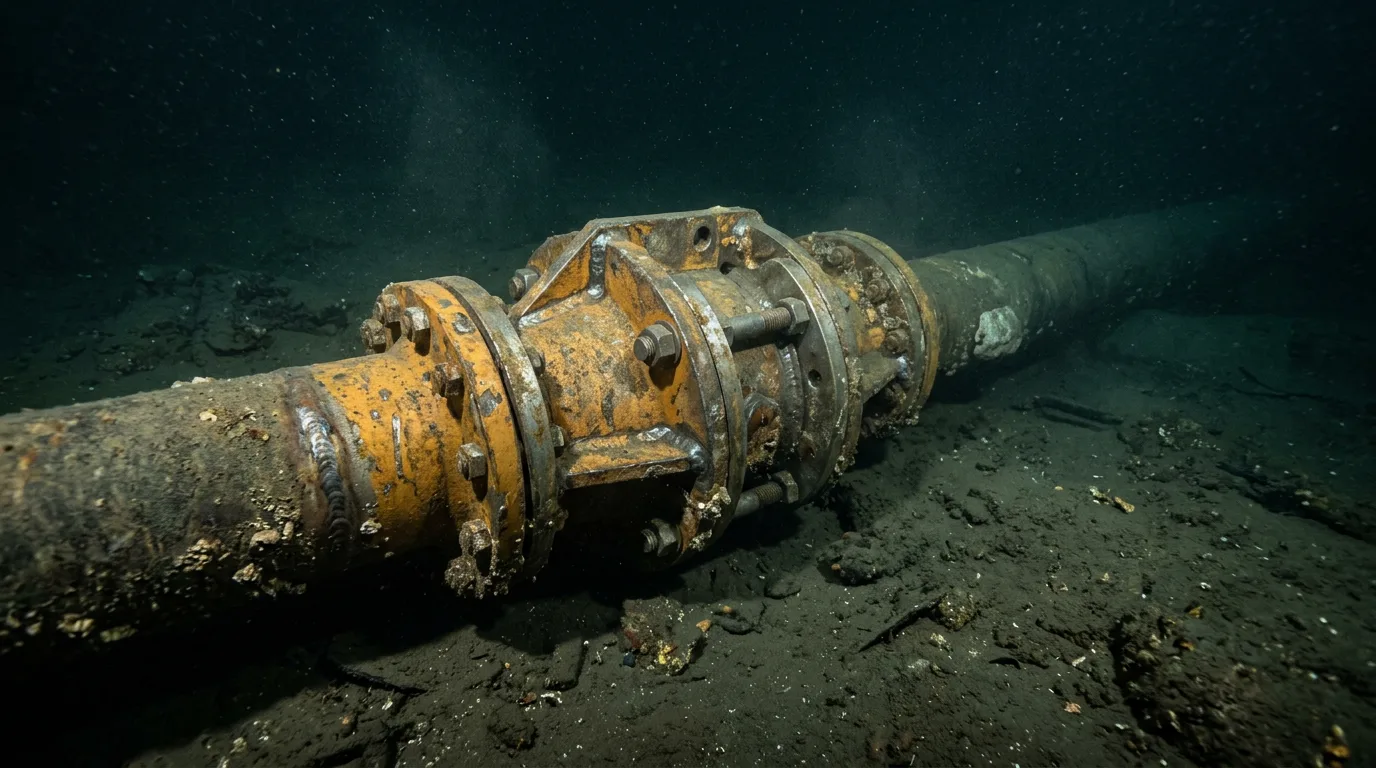
A hydrotest proves strength, but it leaves the line full of water that natural gas service can't tolerate. Free water sitting in low points and pig-trap pockets, plus the film on the pipe wall, combines with gas to form hydrates once pressure rises and the gas expands through a valve or regulator. Hydrate plugs block lines, damage instruments and force emergency venting. If the gas carries CO₂ or H₂S, residual water also feeds internal corrosion, and that starts on day one. Water that reaches dehydration units or custody-transfer metering can push the downstream system off-spec.
The tricky part is that a line can look dry and still be wet. Bulk water leaves with the pigs, but a film stays on internal surfaces and water pools in low areas. Drying has to continue until the acceptance criterion is met. So write that criterion down, measure it and get it agreed before the first pig goes in.
Standards and requirements context
No single document sets one universal dryness number. The governing code sets the testing and commissioning framework. The project specification or operator procedure sets the moisture criterion.
ASME B31.8, Gas Transmission and Distribution Piping Systems, covers design, construction, testing and operation of gas pipelines, including pressure testing.CSA Z662, Oil and gas pipeline systems, is the equivalent framework for Canadian projects.- In the United States, 49 CFR Part 192 (Transportation of Natural Gas and Other Gas by Pipeline: Minimum Federal Safety Standards) governs testing and commissioning of regulated gas lines.
Operator procedures fill in the drying detail. Pacific Gas and Electric's utility procedure TD-4137P-03 (2021), for example, describes how to determine whether a pipeline needs drying after hydrostatic testing and which methods to apply. Project specifications such as SPC-SPC-011, Hydrostatic Testing, Dewatering and Drying, show how an owner packages these requirements into one document. The literature tells the same story. The International Pipeline Conference paper How Dry Is Dry? (2018), the GATE Energy overview Gas Pipeline Drying Methods (2013) and the older state-of-the-art review of drying large-diameter gas pipelines (1982) all wrestle with acceptable dryness, which has been argued for decades and depends on the service.
Dewatering: getting the bulk water out
Drying can't start until bulk water is gone. Most wasted drying time traces back to poor dewatering.
Foam pig runs
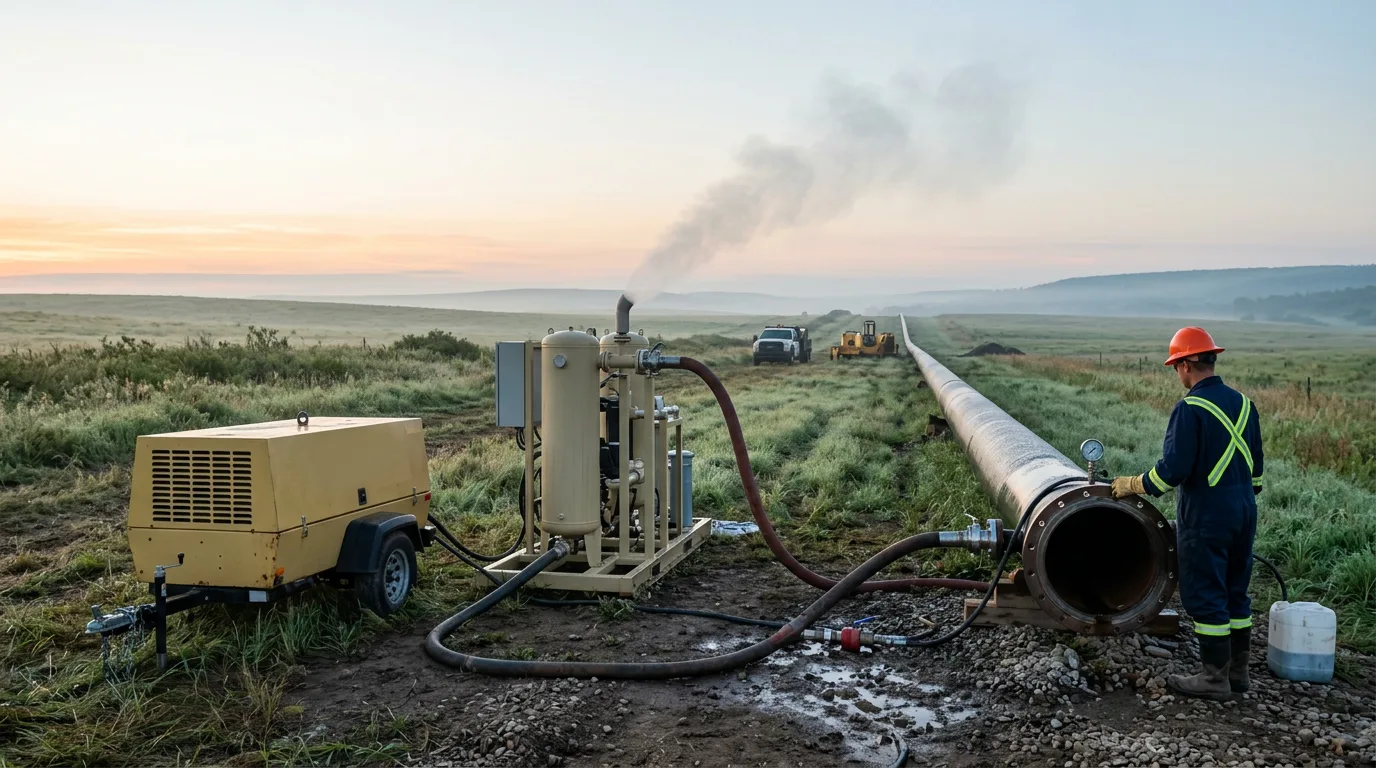
Foam pigs do the final dewatering job on most jobs. They conform to the bore, get past minor restrictions and wipe the wall. Practical points:
- Propel dewatering pigs with dry compressed air or nitrogen, never wet or unconditioned air. Any moisture in the drive gas ends up in the line you're trying to dry.
- Run a train of pigs, not one. Early runs push out bulk water and later runs wipe the film. Read the water discharged at the receiver and the condition of each pig. When successive pigs arrive with little water ahead of them and come out only damp, bulk removal is done.
- Check pig wear after each run. A badly worn pig has bypassed water, and the next run will carry more.
- Profile matters. Pigs stall or bypass at low points, elevation changes and heavy-wall transitions. Review the elevation profile and fittings (tees, reducers, valves) before you pick the pig type and drive pressure.
- Confirm the receiver, drain and disposal arrangements can handle the water volume. Test water often needs controlled discharge under the project's permit.
What foam pigging does not do
Foam pigs leave a wall film behind. They also can't clear water trapped in dead legs, bypass lines, instrument tappings and valve cavities. That's where residual moisture hides after a dewatering run that looked like a success.
Drying methods compared
| Method | How it works | Best suited to | Main limitations |
|---|---|---|---|
| Dry-air drying | Dehydrated air flows through the line and carries away vapour; dew point is monitored at the outlet | Long lines, large diameters, lines where air is acceptable | Needs adequate dry-air supply; slow if free water remains; air is not suitable where a flammable atmosphere could form |
| Nitrogen drying | Same principle with nitrogen as the drying gas | Lines where an inert atmosphere is required, or reinstated lines | Higher gas cost; asphyxiation hazard at vents |
| Vacuum drying | Pressure is lowered below the vapour pressure of water at pipe temperature so the water evaporates | Shorter sections, complex piping, lines with low points | Cold pipe slows evaporation and ice can form; needs good leak tightness; large volumes need large pumping capacity |
| Swabbing with hygroscopic liquid (methanol or glycol) | Slugs of liquid between pigs absorb residual water | Lines that are difficult to dry otherwise, or where time is short | Liquid disposal; compatibility with downstream processes; contamination concerns |
Choosing a method usually comes down to line length, diameter, ambient temperature, available dry gas, schedule and how much residual water the project can live with. Many projects run foam pigging followed by dry-air or nitrogen drying, and save vacuum drying for short or awkward sections.
Dew-point targets
The dryness target is stated as a dew point: the temperature at which water vapour in the gas starts to condense. Industry practice, as set out in current service-provider literature, uses these pressure dew-point bands:
| Dew-point target | °F | °C (calculated) |
|---|---|---|
| General drying | −20°F | −28.9°C |
| Common for natural gas pipelines | −40°F | −40.0°C |
| Critical gas service | −60°F to −100°F | −51.1°C to −73.3°C |
Conversion used: °C = (°F − 32) × 5/9. For example, −20°F gives (−20 − 32) × 5/9 = −52 × 5/9 = −28.9°C, and −40°F gives (−72) × 5/9 = −40.0°C.
For natural gas pipelines, −40°F or lower is commonly specified. Don't pull the number off a table. Tie it to the real operating envelope:
- The dew point should sit below the lowest temperature the pipe wall or gas will see at operating pressure. That includes buried sections, river crossings and above-ground runs in winter.
- Gas composition matters. Hydrate formation temperature rises with pressure and with certain components. A high-pressure line with cold-ground sections needs a tighter target than a low-pressure distribution main.
- Downstream sensitivity matters. Lines feeding cryogenic processes, instrument-air-like users or storage should take the drier end of the range.
- State whether the target applies at line pressure or atmospheric pressure. The two differ significantly, and confusion between contractor and owner is a common source of disputed acceptance.
Verifying dryness
Inlet-to-outlet dew-point comparison
You verify drying progress by measuring the gap between inlet and outlet dew point. Call it complete when the outlet readings stabilise at or below target, with the outlet approaching the inlet. One low reading doesn't count as acceptance. A sustained period of stability does.
Instruments
- Chilled-mirror hygrometers are the reference method because they measure dew point directly. They're sensitive to contamination, so sample conditioning matters.
- Capacitance probes (aluminium oxide or polymer) are rugged and common in the field. Check calibration and response time before the job, since they can lag in very dry gas.
- Use sample line made of suitable material. Long or poorly chosen tubing absorbs and releases moisture. You get a falsely wet reading that falls slowly, or a falsely dry one when the sample is drawn from a dead leg.
Hold (static) tests
Once the outlet dew point reaches target, isolate the line and hold it. Any residual water re-evaporates into the static gas and the dew point climbs. For vacuum-dried sections, isolate from the pump and watch pressure instead. A rise that levels off at a low value points to a tight line with little water. A continuing rise means water or a leak. Set the hold duration and the allowable change in the specification before you start. Don't decide them after you've seen the result.
Safety during dewatering, drying and gas-in
Pig launchers and receivers, vents and tie-ins are where the hydrocarbon hazards concentrate. For any activity that opens, depressurises or inspects hydrocarbon-containing equipment, including reinstated lines that have held gas:
- Isolate the section with positive isolation and depressurise it through a controlled route.
- Verify zero energy at the trap, including gauges and bleed points, before you open any closure. Pig receivers can hold trapped pressure behind or ahead of a pig.
- Apply lock-out/tag-out to isolation valves and to the drive-gas supply.
- Treat the area as hazardous. Use appropriately rated equipment and control ignition sources.
- Use calibrated portable gas detection for hydrocarbons and, where nitrogen is used, for oxygen deficiency.
- Vent to a safe location, directed away from personnel, with exclusion zones during pig launch and receipt. Never stand in line with a trap door or in the path of a pig and discharging fluid.
Never introduce natural gas into a section that still contains air without a defined purging step. Skip it and you risk a flammable mixture.
Illustrative scenario
This is an illustrative example, not a reported project. A new gas lateral crosses a river and runs through exposed terrain. After hydrotest, the contractor runs a train of foam pigs with dry air. The early pigs push out large water volumes. By the final pigs, the receiver sees little water. The contractor starts dry-air flow, and the outlet dew point falls quickly, then plateaus well above the specified target.
A plateau usually means water is hiding somewhere. The team checks the profile and finds the low point at the river crossing. They run another foam pig, which carries out a further slug, and the dew point resumes its fall. The outlet stabilises at target with only a small difference from the inlet. The team isolates the line for the hold test. The dew point rises slightly and then levels off, inside the limit written in the specification. The owner accepts the result, and gas-in proceeds under the commissioning procedure.
The lesson: a plateau should send you looking for trapped water, not extend the drying time. More air through a section that still holds liquid water is slow and expensive.
Checklist for drying and commissioning
- Confirm the dew-point target, whether it is stated at line pressure or atmospheric pressure, and the stability and hold-test criteria before mobilisation.
- Base the target on the lowest expected operating temperature, gas composition and operating pressure.
- Review the elevation profile and list low points, dead legs, valve cavities and branch connections for specific attention.
- Specify dry drive gas for all pigging runs and verify its dew point at the compressor or generator outlet.
- Plan water discharge, handling and permits before the first pig is launched.
- Run foam pigs in a train and record water volume and pig condition for each run.
- Select the drying method according to length, diameter, temperature, gas supply and schedule.
- Calibrate dew-point instruments and use a proper sample-conditioning line.
- Record inlet and outlet dew point against time, and confirm the outlet has stabilised at or below target.
- Carry out the hold test and record the result against the agreed limit.
- Verify isolation, zero energy, LOTO, gas detection and safe venting for every trap and vent operation.
- Use a defined purge step before introducing natural gas, and keep the dew-point records in the commissioning file.
Conclusion
Dryness is a measured, agreed acceptance criterion. It doesn't come for free with pigging. Set the dew-point target from the operating envelope and the downstream sensitivity. Dewater thoroughly with a foam pig train driven by dry gas. Choose the drying method for the geometry and schedule. Accept the line only on a stable outlet dew point at or below target, confirmed by a hold test.
As a next step, take your current commissioning specification and check three things: whether the dew-point target is tied to the lowest operating temperature, whether it states line or atmospheric pressure, and whether the hold-test limit is defined before work starts. Where any of these is vague, resolve it with the contractor before mobilisation.