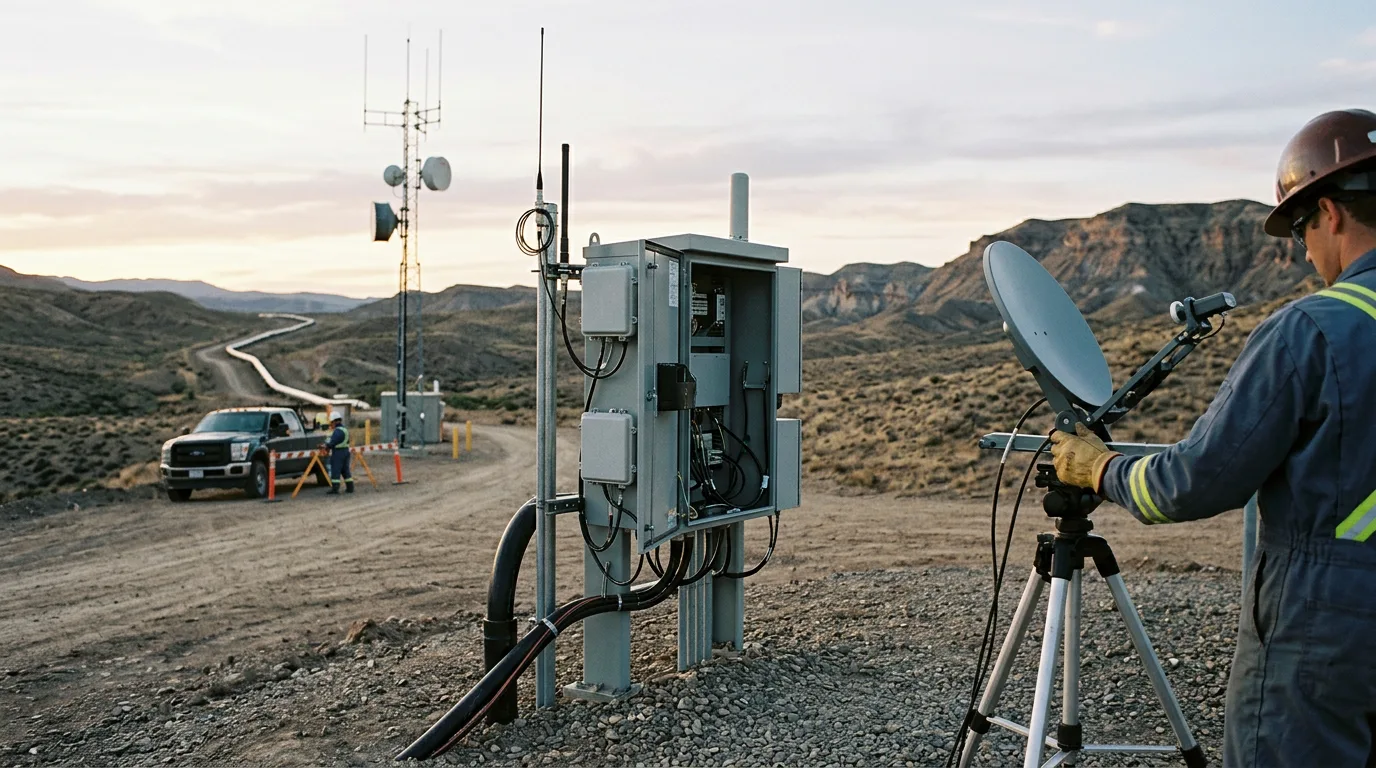
Redundant SCADA Telemetry Design for Remote Pipelines: Radio, Fiber, and Satellite Trade-offs
When a comms link drops on a remote pipeline segment, you don't just lose data. You lose the pressure excursion, the compressor trip, the first hint of a leak. Nobody sees any of it until a technician drives out to site or the link comes back on its own. Depending on operating pressure and product, that blindness window translates directly into regulatory exposure, environmental liability, and the possibility of a delayed emergency shutdown. Designing redundancy into the telemetry architecture before commissioning is substantially cheaper than retrofitting it after an incident.
Three backhaul technologies carry most of this traffic: licensed radio, fiber optic, and satellite. This article compares them on the parameters that matter most to instrumentation and control engineers — latency, availability, failover behaviour, and the RTU/SCADA configuration choices that make redundancy work in practice.
Standards and Requirements Context
Pipeline SCADA communications sit at the intersection of several regulatory and standards frameworks. IEC 62351 addresses security for power systems and communication networks; IEC 62443 is the primary standard for industrial automation and control systems security, and operators cite it more and more for pipeline OT networks. IEC 61511 governs functional safety for process industries — it becomes directly relevant when the telemetry link carries SIS-related data or remote ESD commands. NERC CIP standards apply where pipeline assets intersect with electric utility infrastructure. Before finalising architecture, confirm which standards have contractual or jurisdictional force on your specific asset.
Technology Characterisation
Licensed Radio (UHF/VHF and Licensed Microwave)
Where line-of-sight or near-line-of-sight paths exist, licensed radio is still the dominant primary link for onshore pipeline SCADA. Latency is low. The round-trip poll cycle is set by the radio modem and protocol stack, not by orbital geometry, which makes it well-suited to high-frequency polling and fast alarm response. Bandwidth is constrained compared to fiber, but pipeline RTU payloads are typically small — status words, analog measurements, the occasional waveform capture. Those don't saturate a licensed channel.
Path engineering is where the design lives or dies. Terrain obstructions, Fresnel zone clearance, and co-channel interference must all be evaluated before a frequency licence application goes in. And every repeater is another failure node: its own power supply, its own enclosure, its own maintenance access.
Store-and-forward capability in the radio modem lets an RTU buffer data through a link outage and flush the buffer on reconnection. Historian continuity survives without operator intervention.
Fiber Optic
Fiber gives you the highest bandwidth, the lowest latency, and full electrical isolation. Of the three technologies, it wins on all three counts. On pipelines that follow a right-of-way corridor, fiber installed in the same trench as the pipe becomes a dedicated, high-capacity backbone.
The availability risk is physical damage. Third-party excavation, ground movement, and flooding are the leading causes of outage. One fiber cut can isolate an entire pipeline segment if no redundant path exists. Ring topologies or diverse-route fiber segments fix that — at significant capital cost. Fiber is rarely the right answer for an individual wellhead or valve site connection. It earns its keep as a trunk linking pump stations or compressor stations that already have permanent infrastructure.
Satellite (GEO and LEO/MEO)
Satellite is the backhaul of last resort, the option for sites where no terrestrial infrastructure exists or can be economically justified. GEO systems impose a propagation delay that falls straight out of orbital altitude. That latency rules out closed-loop control and puts a noticeable lag into alarm acknowledgement workflows.
LEO constellations cut propagation delay significantly and improve suitability for supervisory polling, though they are not yet a substitute for licensed radio in latency-sensitive applications. Satellite bandwidth is still metered and expensive per bit next to terrestrial options, and that drives protocol efficiency: DNP3 with data compression, report-by-exception rather than cyclic polling, and careful prioritisation of alarm versus trend data.
Rain fade, antenna pointing errors, and constellation outages all hit satellite availability. Redundant modems or dual-antenna configurations address some of these failure modes.
Comparative Summary
| Parameter | Licensed Radio | Fiber Optic | Satellite (GEO) | Satellite (LEO) |
|---|---|---|---|---|
| Latency | Low | Very low | High (orbital physics) | Moderate |
| Bandwidth | Moderate | High | Low–moderate, metered | Moderate, metered |
| Primary failure mode | Path obstruction, equipment | Physical cable damage | Rain fade, antenna | Constellation outage |
| Failover speed | Fast (seconds) | Fast if ring topology | Slow if re-acquisition needed | Moderate |
| Best fit | Primary link, repeater chains | Trunk between major stations | Last-resort or primary backup | Remote primary with lower latency need |
| Infrastructure dependency | Repeater sites, licensed spectrum | Trench, duct, splicing | VSAT hardware, NOC contract | Terminal hardware, service contract |
Table values are qualitative characterisations based on technology physics and referenced source descriptions. No numeric thresholds are implied.
Failover Architecture and RTU Configuration
Redundancy is only as useful as the failover logic that activates it. Failover behaviour sits squarely in the availability pillar.
A common architecture pairs a licensed radio primary link with satellite backup at each remote site. The RTU monitors link health continuously. When the primary link fails, the RTU switches to the backup path autonomously rather than waiting for a poll timeout at the master station. The master station SCADA then has to handle the path change transparently — address routing, polling rate adjustments for the higher-latency backup path, and alarm suppression for the communication state changes you expect during switchover.
The Cisco CVD for connected pipeline systems recommends a hierarchical network design with clearly defined aggregation points. Get that structure right and a single link failure isolates only the segment between two aggregation nodes, not the entire pipeline — provided the aggregation nodes themselves have redundant uplinks.
Now the hard case: both links fail at once. It happens during severe weather events that take out radio propagation and satellite availability together. The RTU must keep executing its local control logic and keep buffering data. On link restoration, the SCADA historian receives the gap-filled record. Leak detection algorithms need continuous flow and pressure data, so this one matters.
Illustrative Scenario
The following is illustrative and does not represent a specific named project.
Take a gas transmission pipeline with valve stations spaced at intervals across a remote mountain corridor. Primary telemetry runs on a licensed UHF radio network with intermediate repeaters. A winter storm dumps ice on two repeater antennas and isolates the middle segment of the pipeline from the control room.
Single-path design, and operators lose visibility to that segment entirely. Dual-path design, and each valve station RTU automatically routes alarms and critical analog data through a GEO satellite backup. Polling rates drop on the satellite path to manage bandwidth costs, but ESD commands and high-priority alarms still pass within an acceptable window. The ice clears, the radio path recovers, the RTUs switch back to the primary link, and they flush buffered trend data to the historian. The control room ends up with a complete record and no gap in the leak detection dataset.
Design Checklist
Before finalising a remote pipeline telemetry architecture, verify the following:
- [ ] Path studies completed for all radio links; Fresnel zone clearance confirmed at worst-case foliage and terrain conditions
- [ ] Repeater sites have independent power (solar/battery or generator) and are included in the maintenance schedule
- [ ] RTU failover logic tested end-to-end: primary failure, backup activation, primary restoration, and data buffer flush
- [ ] SCADA master station polling configuration accounts for higher latency on backup path without generating spurious timeouts
- [ ] Satellite bandwidth budget calculated against worst-case report-by-exception rates; metered overage costs reviewed with procurement
- [ ] Fiber ring topology or diverse-route protection specified wherever fiber forms the primary trunk
- [ ] Cybersecurity controls (encryption, authentication) applied consistently across all link types; do not assume satellite or radio links are inherently isolated
- [ ] Store-and-forward buffer size at each RTU sized against the longest credible dual-link outage duration
- [ ] Communication status displayed explicitly in the SCADA HMI per
API 1165display guidance - [ ] Failover events logged and reviewed periodically to identify chronic link degradation before it becomes an outage
Conclusion
No single telemetry technology is optimal across all remote pipeline conditions. For most onshore applications, licensed radio gives the lowest latency and fastest failover, but it demands disciplined path engineering and repeater maintenance. Fiber is the right backbone technology between major stations with permanent infrastructure, and without ring protection it is vulnerable to physical damage. Satellite fills the coverage gaps where no terrestrial option exists, and you pay for that in latency and ongoing bandwidth expense.
The next step is the same for any design team: map each pipeline segment against the three technologies using the criteria in the comparison table, flag the segments that have no viable terrestrial primary, and size the satellite backup capacity against realistic polling and alarm rates. On RTU selection, confirm store-and-forward capability and autonomous failover without master station intervention. And engage your spectrum licensing authority early — licensed radio frequency assignments in remote corridors can take months to secure, and they should not be on the critical path to commissioning.