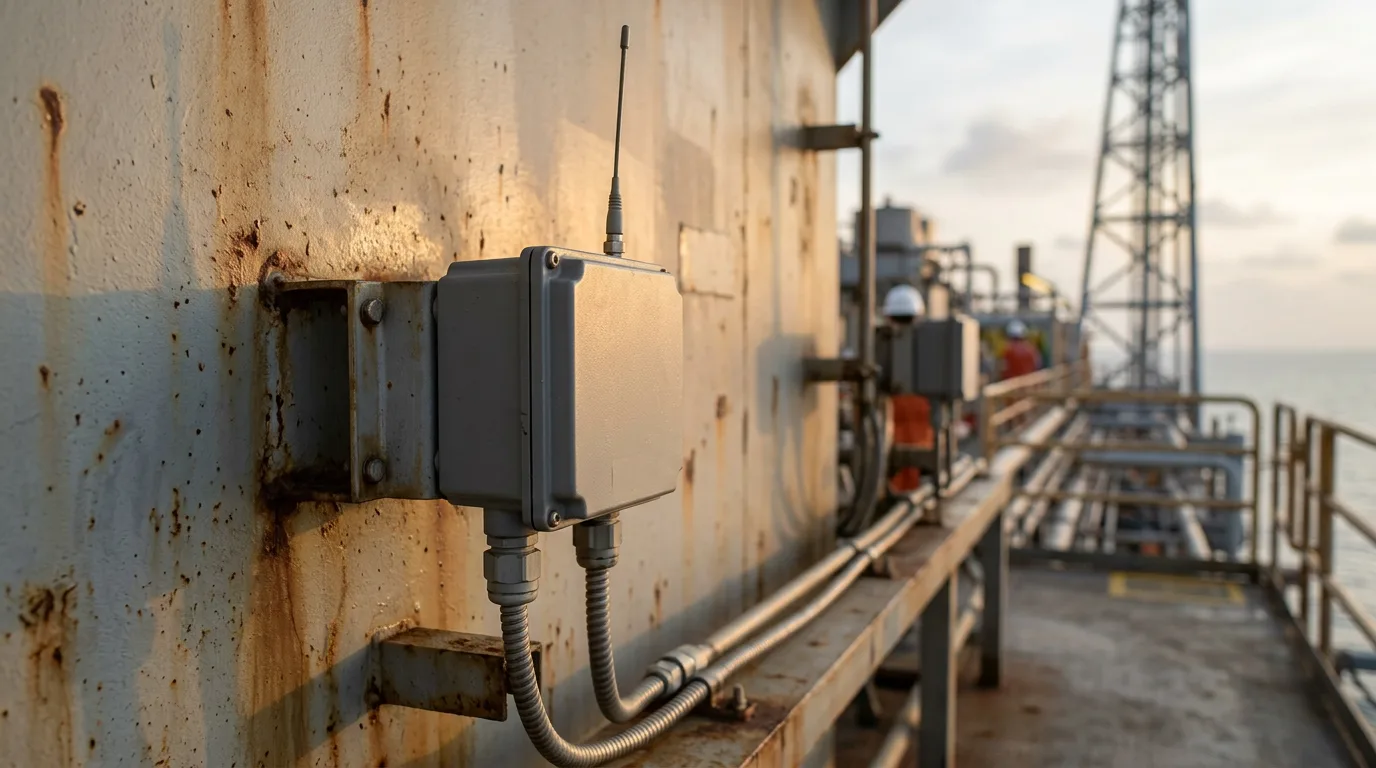
Offshore platforms are crowded, congested and difficult to modify. Running new cable for a single transmitter means cable tray capacity, penetrations through fire and gas-tight boundaries, hot-work permits and often a shutdown window. Instruments that stay unmonitored because wiring is too costly leave gaps in corrosion, vibration, tank, relief-valve and equipment-health data. Wireless fills those gaps, but a poorly planned network trades one problem for another. Intermittent data erodes operator trust, a flat network invites intrusion, and batteries and gateways become unmanaged assets. This article covers WirelessHART and ISA100 deployment, radio planning on steel structures, and security hardening for brownfield platforms.
Standards and requirements context
The standards below frame most wireless instrumentation projects:
- IEC 62591 covers the WirelessHART communication network and profile.
- IEC 62734 covers the ISA100.11a wireless network and profile.
- IEC 62443 is the series on network and system security for industrial automation and control systems. Its zone-and-conduit model is the practical basis for segmenting wireless gateways from the control network.
- IEC 61511 covers functional safety for safety instrumented systems in the process sector. It governs whether a wireless link may sit anywhere near a safety function.
- IEC 60079-0 sets the general requirements for equipment in explosive atmospheres. Every field device, antenna and gateway in a classified area needs appropriate certification for that area.
Two practical consequences follow. First, wireless on brownfield platforms is best aimed at monitoring and non-critical control, which matches how the industry has used it. Emerson's discussion of appropriate uses describes wireless proving its value in remote, hard-to-reach locations where the cost of wiring was prohibitive. Second, any proposal to use wireless data in a trip or shutdown path needs explicit treatment in the IEC 61511 safety requirement specification, including how communication loss is detected and what the safe state is.
Technical body
Choosing between WirelessHART and ISA100.11a
Both are IEEE 802.15.4-based, time-synchronised, channel-hopping mesh technologies with managed security. The decision usually turns on existing asset base and integration, not radio performance.
| Criterion | WirelessHART (IEC 62591) | ISA100.11a (IEC 62734) |
|---|---|---|
| Device ecosystem | Extends the installed HART base and asset-management tooling | Broader protocol-tunnelling and network architecture options |
| Network layer | HART-oriented application model | IP-based addressing for field devices |
| Topology | Mesh managed by a network manager in the gateway | Mesh or star, with backbone routers to extend coverage |
| Brownfield fit | Strong where HART tooling and spares already exist | Strong where multiple device types and protocols must share one infrastructure |
| Main risk | Gateway is a single point of dependence unless made redundant | Greater configuration flexibility means more to get wrong |
My practical rule: if the platform already runs HART-enabled asset management and the instrument vendor base is established, WirelessHART minimises integration effort and training. If the project wants one wireless infrastructure serving several application types, evaluate ISA100.11a seriously. Do not mix the two casually. Each needs its own gateway, management tooling and security procedures.
Radio planning on a steel structure
Offshore propagation is dominated by metal. RanPlan's offshore planning guidance lists the main considerations: complex steel structures, indoor and outdoor propagation, long-distance maritime coverage, interference, system redundancy, application requirements, and regulatory and safety requirements. Each matters for field-device meshes.
- Do not trust drawings alone. Modules, decks, pipe racks, vessels and cable trays create shadowing and reflections. Early offshore sensor-network research, such as Dalbro et al. (2008), treated platform structure as a central constraint on radio design. A walk-down with a survey tool beats desk prediction.
- Plan for mesh density, not range. Devices relay for each other, so each device should have more than one credible path to the gateway. A single bridging device that serves a whole deck is a design flaw.
- Place gateways deliberately. Mount them where they have good line of sight to the densest device clusters and where they can be reached by fibre or a robust backhaul. Antenna location is a maintenance decision as much as an RF one, since personnel must reach it safely.
- Account for change. Scaffolding, temporary containers, cranes and supply vessels alter the RF environment. Treat the survey as a baseline and repeat it after major modifications.
- Manage coexistence. Platform Wi-Fi, CCTV links, handheld terminals and personnel-tracking systems may share spectrum. Keep a frequency and channel-use register under change control, and test for interference before and after any new radio system is added.
Install a pilot set of devices on the hardest structural areas first, observe path stability and join behaviour over normal operations (including a maintenance campaign if possible), and then scale.
Gateway, backhaul and control-system integration
The gateway is where wireless becomes a telecom and control problem. Its upstream side typically presents data to the DCS, historian or asset-management system through a standard industrial protocol. That upstream link needs the same engineering as any other control-network connection:
- Use redundant gateways for any service that operators rely on, with defined behaviour when a gateway fails over.
- Carry backhaul on the platform's resilient network, ideally fibre with diverse routing, not a single run through one cable route.
- Define in the DCS what a stale or failed value looks like. Mark data quality explicitly so operators never see a frozen reading that appears live.
- Keep wireless-sourced alarms out of critical alarm philosophy unless data-loss handling is designed in.
Wireless also changes the installation workload. The IEEE Sensors paper on a wireless logging system for drilling platform monitoring describes the motivation as reducing the heavy installation and removal effort of wired systems. The same logic applies when equipment is moved or temporary monitoring is added.
Cybersecurity hardening
A wireless field network extends the attack surface beyond the physical perimeter. Sayghe's 2025 literature review on cyber-physical vulnerabilities of wireless sensor networks in oil and gas examines the risk that compromise of a sensor path can affect physical process decisions, not just data confidentiality. examines the cyber-physical vulnerabilities of wireless sensor networks in oil and gas, a useful reminder that compromise of a sensor path can affect physical process decisions, not just data confidentiality.
A brownfield implementation of that list looks like this:
- Treat the gateway as a zone boundary. Under IEC 62443 thinking, place the wireless field network in its own zone, with a controlled conduit to the control network through a firewall or equivalent. Permit only the specific protocols, addresses and directions required.
- Protect join credentials. Join keys and network keys are the root of device authentication. Control who can provision devices, record where keys are held, and avoid reusing one credential across the platform.
- Lock down the management plane. Network-manager and gateway configuration interfaces should be reachable only from a restricted engineering network, with individual accounts and logged changes. Disable unused services.
- Control handhelds and commissioning tools. A laptop or handheld that can join or reconfigure devices is a privileged asset. Manage it as such, including malware control and removal from service when lost.
- Manage firmware. Maintain an inventory of device and gateway firmware versions, and apply updates through management of change with a tested rollback plan.
- Monitor. Watch for unexpected device joins, repeated failed authentication, unexplained topology changes and sustained interference. These can indicate either a fault or an attack, and either deserves investigation.
- Assume denial of service is possible. Radio jamming cannot be fully engineered out. The defence is detecting loss of data quickly and ensuring that process safety never depends on the wireless path.
Reliability and lifecycle management
Gogineni's work on the reliability of wireless instrumentation in oil and gas frames reliability as a system property, spanning devices, network, power and operating practice, and not as a device specification alone. In practice:
- Battery management is the main maintenance load. Update rate, temperature and device diagnostics all drive battery life. Set update rates by the process need, not by what the system allows, and plan replacement from device-reported battery status, not calendar guesses.
- Use network health diagnostics. Trend path stability, neighbour counts, join events and gateway statistics against the commissioning baseline. A sustained downward drift in path quality usually precedes data loss and should trigger a survey, not just a device swap.
- Hold spares and configuration backups. Keep spare devices pre-provisioned where security procedures allow, and back up gateway and network-manager configuration.
- Include wireless in turnaround planning. Scaffolding and equipment changes can cut RF paths. Re-verify the network afterward.
- Handle batteries as hazardous-area items. Replace batteries and open device housings only under the site's hot-work and electrical-equipment procedures for the classified area, using certified parts. Never open a device in a hazardous area without a permit covering it, and observe the gas-testing requirements.
Illustrative scenario
This scenario is illustrative and does not describe a real project.
An operator wants wireless monitoring on an older production platform. The target points are vibration on several rotating machines, corrosion probes on process piping, and tank levels in a congested utility module. A wired option would require new tray routes through a fire-rated boundary.
The team follows this sequence:
- Walk down the platform with an RF survey tool and choose gateway locations that have fibre access and line of sight to the densest clusters.
- Install a pilot set in the utility module, since steel density there is the worst case. Observe path stability over a normal operating period and through a maintenance activity.
- Add redundant gateways and map each gateway to a dedicated firewall interface, allowing only the data protocol the DCS needs.
- Provision devices from a controlled engineering station, record key custody, and disable unused gateway services.
- Configure the DCS to flag stale data distinctly. Keep all wireless points outside trip logic, as the safety requirement specification states.
- Record the survey and baseline diagnostics as the commissioning reference, and schedule a re-survey after the next major structural change.
The result is a monitoring network that adds coverage without touching cable trays or safety functions, with a clear, auditable security boundary.
Practical checklist
- Confirm the wireless service is monitoring or non-critical control, and document any proposal to go further under IEC 61511.
- Select WirelessHART or ISA100.11a based on existing asset base, integration, and long-term support, and avoid mixing them without justification.
- Complete a physical RF survey on the actual structure, and plan more than one path per device.
- Pilot the hardest area before full roll-out, and observe it through real operations.
- Maintain a spectrum and channel register, and check coexistence whenever a new radio system is added.
- Verify certification of all devices, antennas and gateways for their hazardous-area classification under the IEC 60079 series.
- Make gateways redundant, with resilient backhaul and defined failure behaviour.
- Define stale-data handling and data-quality flags in the DCS.
- Define the wireless network as a separate IEC 62443 zone with a firewalled conduit.
- Control join keys, management interfaces, handhelds and firmware, with named accounts and logged changes.
- Monitor for unexpected joins, authentication failures and topology changes.
- Plan battery replacement from device diagnostics, under permit in classified areas.
- Re-survey and re-baseline after turnarounds and structural modifications.
Conclusion
Wireless instrumentation works offshore when it is engineered as a telecom and security system, not as a collection of battery-powered transmitters. Start with a clear scope that keeps safety functions off the wireless path, survey the real steel, and pilot in the worst area before committing. Place the gateway boundary under IEC 62443 principles, control credentials and firmware, and trend network health from day one. Next step: set up a pilot in the most congested module, define the security zone and data-quality handling in parallel, and use the pilot results to decide protocol, gateway placement and spares before wider roll-out.