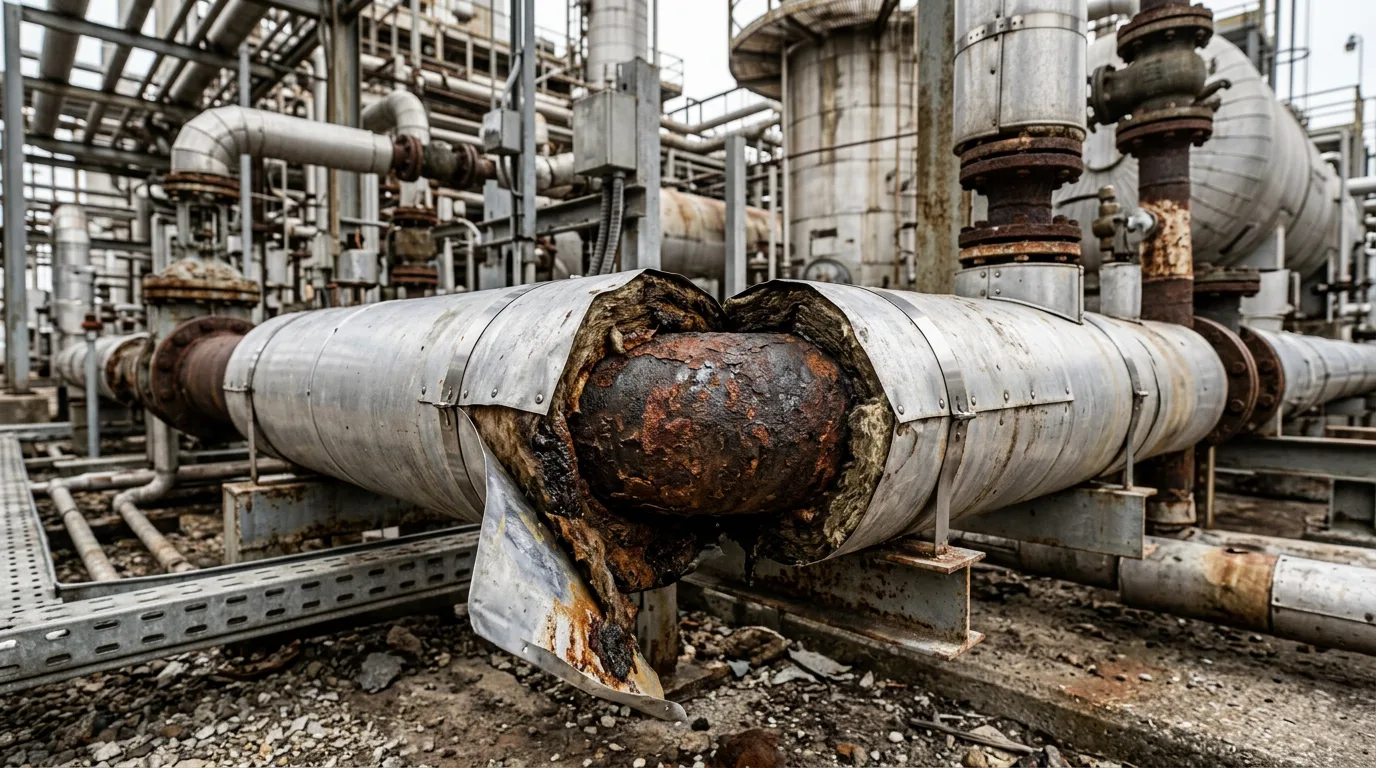
Corrosion under insulation (CUI) is dangerous because the pipe looks fine from outside. The jacket is intact, the cladding paint is acceptable, and nothing shows until a pinhole leak or a wall-thickness measurement says otherwise. On older process piping the exposure is worse. Jacketing has weathered, sealant has aged, original coatings under the insulation may be degraded, and the records of what is insulated, with what, and at what temperature are often incomplete. The cost shows up in two ways. One is an unplanned hydrocarbon release or shutdown. The other is the blanket insulation-stripping campaign, which eats scaffolding, insulation labour and outage time and still misses the worst spots if it isn't aimed at the right lines.
Most operators handle this with risk-based inspection (RBI). This article covers the mechanisms, where the risk concentrates, and how to build a programme for ageing assets.
Standards and requirements context
Several documents apply to a CUI programme on piping:
API 570covers in-service inspection, rating, repair and alteration of piping systems. It is the inspection code framework most piping CUI programmes sit under.API 580andAPI 581cover risk-based inspection and its methodology.API 583addresses corrosion under insulation and fireproofing.NACE SP0198addresses control of corrosion under thermal insulation and fireproofing materials using a systems approach.- DNV-RP-G109 is a recommended practice whose stated objective is a practical, cost-effective, risk-based methodology for managing CUI.
Check your jurisdiction and company standards for which of these are mandatory. The programme should state which document governs inspection intervals and which governs the risk method.
How CUI develops
CUI is localised external corrosion beneath thermal insulation. It starts when water gets past the insulation system and reaches the pipe wall (Kasko Makine). From there the insulation holds that water against the steel, often with chlorides and other contaminants, and hides what is happening underneath.
Typical water sources on older plant:
- Failed or displaced jacket seams, and sealant that has hardened and cracked.
- Penetrations such as supports, instrument connections, vents, drains and tracing entries.
- Leaking steam or heat-tracing tubing.
- Condensation on cold services.
- Washdown, deluge testing and rain driven into damaged cladding.
Two damage modes matter on a mixed-material plant. Carbon and low-alloy steels suffer general or pitting external corrosion, often as localised wall loss that thickness-grid methods can miss. Austenitic stainless steels are not immune. Under the right mix of moisture, chlorides and moderately elevated temperature, they can crack from external chloride stress corrosion, and wall-loss surveys will not catch that. Treat these as separate damage mechanisms with different detection methods.
Temperature and service ranges at highest risk
Temperature decides whether liquid water stays in contact with the metal. Water boils at 100 °C at atmospheric pressure, and that point is a practical boundary:
- Well above the boiling point of water in continuous service: the pipe wall tends to drive moisture out, so insulation tends to stay dry. Risk climbs where the line is shut down, run at reduced rate, or has a dead leg that runs cooler than the main process.
- Around and moderately above the boiling point, and down through ambient: liquid water can persist or cycle between wet and dry, concentrating corrosive species at the wall. This is where carbon steel CUI is most active, and where stainless steel cracking concerns sit at the warm end.
- Below ambient: condensation and ice formation can keep the insulation wet, especially when the vapour barrier is damaged.
- Cyclic or intermittent services: lines that swing through the water boiling point or get idled often are consistently higher risk than steady-state lines.
RBI methodologies, including DNV-RP-G109, use operating temperature as a key ranking factor. Apply it to the real operating envelope, including start-up, shutdown, steam-out and upset conditions. The design-basis temperature on the line list is not enough.
Service and configuration comparison
| Situation | Why it matters | Inspection implication |
|---|---|---|
| Carbon steel, cyclic or intermittent temperature | Repeated wetting and drying concentrates contaminants | Prioritise; combine external survey with targeted NDT |
| Austenitic stainless, warm service, chloride-bearing environment | Risk of external chloride cracking, not wall loss | Use methods that can find cracking; do not rely on thickness grids |
| Dead legs and low-flow branches | Run cooler than the main line, so insulation stays wet | Include in the programme explicitly; they are often missing from isometrics |
| Cold service with damaged vapour barrier | Continuous condensation | Inspect jacket and barrier integrity first |
| Lines near steam tracing or utility leaks | Local, repeated wetting | Link inspection to tracing leak history |
Locations that repeatedly produce findings
Whatever the line class, concentrate on:
- Insulation terminations at flanges, valves and equipment connections.
- Penetrations and support points.
- Low points, elbows and the bottom of horizontal runs, where water collects.
- Vertical runs below a damaged section of jacket.
- Any area where the jacket is dented or displaced, or the sealant has visibly failed.
Drain holes at the bottom of the pipe insulation are a recognised way to release trapped water (MDPI review). They need maintaining. A blocked drain gives a false sense of protection.
Building the risk-based programme for older assets
1. Establish the population and fill the data gaps
Start from the line list, P&IDs and isometrics. For each insulated line or circuit, capture the material, operating temperature envelope, insulation type, jacket type, age of the insulation system, and any coating under the insulation. Add leak history, previous strip findings and any steam-tracing history.
On older assets this data is often incomplete. The ICorr Annual Corrosion Forum material includes guidance on what to do when there is no data. In practice, assume the worse case for the missing field, record that you did so, and let field findings replace the assumption over time.
2. Assess probability and consequence separately
Risk-based inspection combines the probability of CUI damage with the consequence of failure, so that inspection effort lands where it matters most (iFactory). That does not mean every pipe with wet insulation needs immediate stripping.
Probability drivers:
- Operating temperature relative to the water boiling point, and the degree of cycling.
- Condition of jacket, sealant and vapour barrier.
- Age and type of insulation system, and whether it holds water.
- Coating condition under the insulation, where known.
- Presence of tracing, nearby water sources, and the local environment.
- Previous findings on the same circuit or a similar one.
Consequence drivers:
- Fluid hazard (flammable, toxic, high-pressure).
- Release location relative to personnel, ignition sources and critical equipment.
- Environmental impact and production dependency.
Rank the lines into groups and set inspection scope and frequency to match the combined risk. The API 581 methodology and DNV-RP-G109 both give structured ways to do this. An earlier paper on using RBI results to justify and manage a CUI programme (ETCE, 2002) makes the same point: RBI output should drive the programme scope, not sit beside it.
3. Match the inspection method to the damage mechanism
Use a tiered approach:
- External survey of jacket and insulation condition, at the level of detail of an
API 570external inspection. - Non-intrusive screening, such as profile radiography or pulsed eddy current, to find where insulation is wet or wall loss is likely. HOIS-G-023 covers in-situ CUI inspection.
- Targeted insulation removal at the locations flagged by screening and by the high-risk configurations above, with visual inspection and direct thickness measurement or crack detection on the exposed metal.
- Full-circuit stripping, but only where findings show the damage is widespread.
4. Recognise what RBI cannot do
A review of CUI in oil and gas notes that RBI is widely sought after for CUI prediction and mitigation, but where corrosion failure has severe consequences it may not be reliable enough (MDPI review). For high-consequence lines with weak data, a low probability score does not replace physical inspection. Treat the model as a prioritisation tool and check it against findings.
5. Close the loop
Every finding, including "no damage found", should update the probability ranking for similar lines. Record the location, the insulation condition, the damage found and the apparent water source. The AMPP paper on RBI for CUI and corrosion under fireproofing (2024) covers both threats under one RBI approach. If your plant has fireproofed steel and insulated piping, manage them together.
Safety when opening insulation on in-service piping
Pulling insulation off live hydrocarbon lines is not a trivial job. Before any work that could expose the pipe wall or involve intrusive access:
- Confirm the line status through the permit-to-work system, and identify the hazardous-area classification of the work zone.
- If the inspection or any repair means opening the process boundary, isolate the line, depressurise it, vent to a safe location, and verify zero energy before work starts.
- Apply lock-out/tag-out to isolation points.
- Use calibrated gas detection throughout, and control ignition sources, including tools used for jacket removal.
- Assume a corroded wall may be thinner than nominal. Do not apply loads, hammer or lever against a section where wall loss has not been assessed.
- Restore the insulation, jacket and sealant to a standard that sheds water. Do not leave temporary coverings in place.
Illustrative scenario
This scenario is illustrative, not a reported case. A legacy gas-processing unit has carbon steel and austenitic stainless piping, original insulation, and incomplete isometrics. The team screens all insulated lines by temperature envelope, cycling and jacket condition. A group of intermittently used carbon steel lines with visibly failed jacket seams ranks highest, along with a set of dead-leg branches that appear on the P&IDs but not in the inspection database. A stainless steel line in warm service near a coastal-exposed area is ranked separately for cracking susceptibility.
The team applies the tiered method. External survey and non-intrusive screening cover the high-ranked group, and insulation comes off only where screening indicates wetness or wall loss. Suppose the first dead-leg strips show wall loss at the low point where water collects. Those findings move the remaining dead legs up the ranking and add them to the next campaign. Lines screened and found dry with intact jackets drop down the ranking, and their interval extends in line with API 570 and the plant's RBI procedure.
Practical checklist
- Is every insulated line in the inspection database, including dead legs and branches?
- Is the operating temperature envelope based on real operation, including shutdowns and cycling?
- Have missing data fields been assigned conservative assumptions and flagged for correction?
- Are carbon steel wall loss and stainless steel cracking treated as separate mechanisms?
- Are terminations, penetrations, low points and damaged jacket areas on the inspection scope?
- Does each high-consequence line have physical inspection, not just a model score?
- Are drain holes, where fitted, checked and kept open?
- Are findings, including negative ones, fed back into the risk ranking?
- Do work packs for insulation removal include isolation, depressurisation, zero-energy verification, LOTO, gas detection and hazardous-area controls?
- Is reinstatement quality of jacket and sealant checked and signed off?
Conclusion
An effective CUI programme on ageing piping starts with a complete population, ranks lines by temperature behaviour, jacket condition and consequence, and then uses the cheapest method that can find the damage mechanism in question. Treat RBI as a way to direct inspection, not a replacement for it, particularly where failure would be costly and the data is thin.
As next steps, audit your insulated-line inventory for missing dead legs and unknown temperatures, rank the population using DNV-RP-G109 or your API 581 implementation, and schedule targeted screening and strips on the highest-ranked group. Then use the findings to revise the ranking before the next campaign.