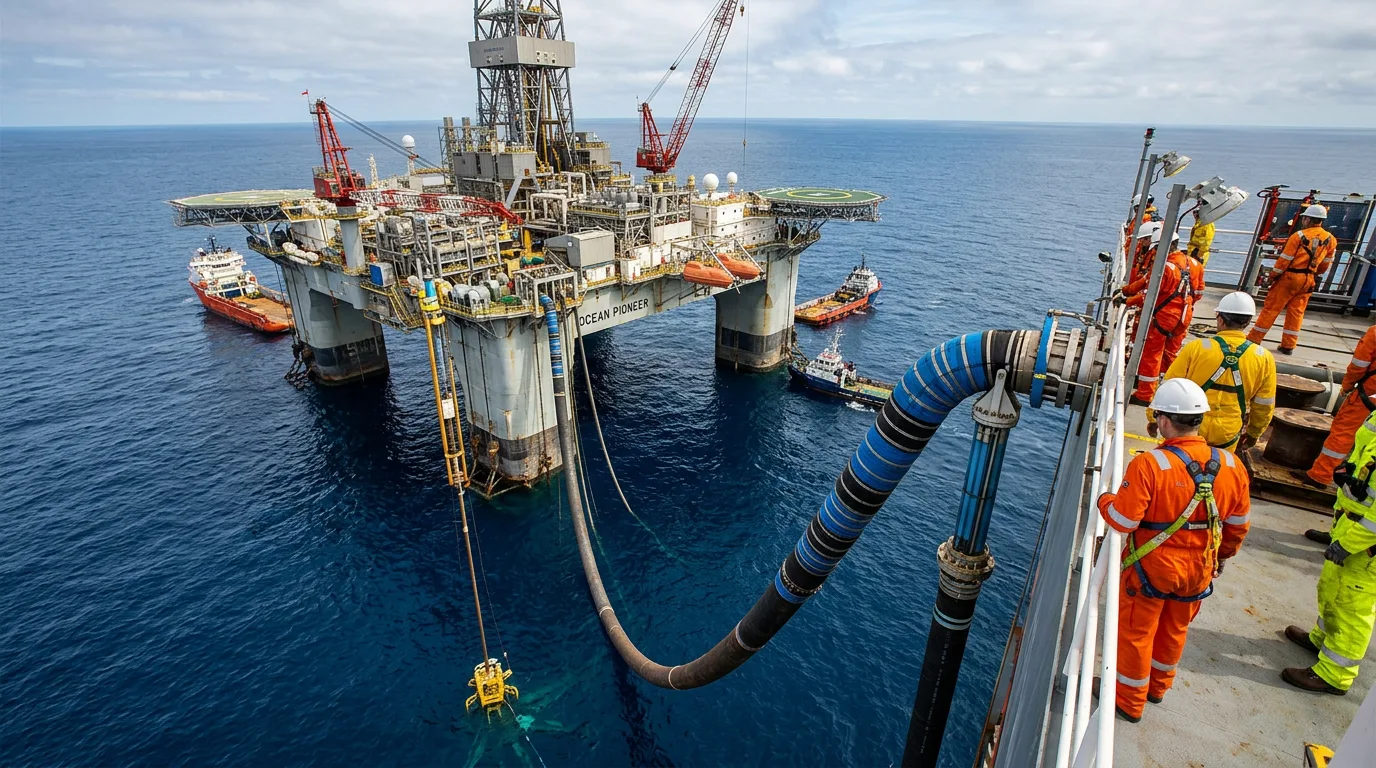
Riser Selection for Deepwater Tiebacks: Flexible Pipe, SCR, or Top-Tensioned
Pick the wrong riser system for a deepwater tieback and you own the consequences for decades — fatigue management, intervention costs, or lost production. At concept screening the answer is rarely obvious. Each technology carries its own envelope for water depth tolerance, host vessel compatibility, and fatigue performance, and a mismatch between riser type and operating environment has derailed more than one project after a serious front-end engineering spend.
This article compares flexible risers, steel catenary risers (SCRs), and top-tensioned risers (TTRs) against the criteria that decide early tieback screening: water depth, host vessel motion, pressure and temperature rating, fatigue life, and installed cost trajectory.
Standards and Requirements Context
Riser design for deepwater tiebacks is governed by a handful of documents. Keep these within reach during screening:
API RP 2RDcovers design of risers for floating production systems and tension-leg platforms.API RP 17Baddresses flexible pipe for subsea applications, including minimum bend radius, end-fitting qualification, and service life assessment.API RP 17Caddresses flexible pipe design, installation, and inspection for subsea applications.DNV-OS-F201(nowDNVGL-ST-F201) is the primary standard for dynamic risers, covering limit-state design, fatigue analysis methodology, and material requirements.
BSEE's deepwater riser fatigue study (Project 572) is useful regulatory context — it shows how these standards interact, and where the gaps sat as of the mid-2000s.
The Three Riser Archetypes
Flexible Pipe Risers
Flexible risers use a multilayer unbonded construction — interlocked steel carcass, pressure armour, tensile armour layers, polymer sheaths. That cross-section is what buys the bending compliance. The pipe absorbs large vessel offsets and motions without dumping heavy dynamic loads into the hang-off point.
The real advantage at screening stage is geometric versatility. One flexible riser can be run as a free-hanging catenary, lazy wave, steep wave, or pliant wave, depending on the motion environment and how much you need to decouple vessel dynamics from the seabed touchdown zone. Lazy wave — a buoyancy section creating a mid-water arch — is the usual pick for FPSOs in high-motion environments. It soaks up vessel heave before it reaches the lower section.
Hydrostatic collapse is the constraint that bites. Go deeper and the external pressure on the annulus between armour layers climbs; eventually the collapse resistance of the unbonded construction governs, not the internal pressure rating. Make the manufacturer run explicit collapse analysis at screening. Don't assume a catalogue product covers the target depth.
Then there's end-fitting integrity, which is the primary inspection and integrity concern across the service life. Annulus flooding — end-fitting degradation, outer sheath damage, either one — accelerates armour wire corrosion and can cut fatigue life hard. Usually with no visible external sign.
Steel Catenary Risers
An SCR is a continuous steel pipe hung off the host in a catenary curve, running from a near-vertical hang-off angle at the top down to a shallow touchdown angle at the seabed. For deepwater tiebacks the appeal is simplicity: no intermediate buoyancy hardware, no complex cross-section to manufacture, and direct compatibility with standard pipeline welding and inspection techniques.
In a tieback, the riser connects a new subsea well or manifold to an existing platform that was not originally designed with that riser in mind. This creates three compounding problems:
- The existing platform's riser porches, pull-in arrangements, and structural capacity may constrain hang-off angle and top-tension options.
- The tieback flowline may operate at pressures and temperatures outside the original platform's riser design envelope.
- Fatigue loading at the touchdown point and at the top connection is driven by the host vessel's motion response, which is fixed and cannot be optimised for the new riser.
Look at the high-pressure tieback SCRs for K2 in the Gulf of Mexico. The interaction between platform motion, SCR hang-off geometry, and fatigue damage accumulation at the weld heat-affected zones near touchdown needed close attention. High internal pressure combined with dynamic bending at touchdown gives you a stress state that has to be resolved through careful wall thickness selection, weld procedure qualification, and, in some cases, distributed buoyancy to lift the touchdown zone and reduce curvature.
SCR fatigue is dominated by two mechanisms: wave-frequency vessel motion driving cyclic bending at the top and at touchdown, and vortex-induced vibration (VIV) along the suspended length. VIV suppression hardware — helical strakes or fairings — adds installation complexity and cost, but in current-exposed deepwater Gulf of Mexico or West African locations it is often non-negotiable.
The BSEE fatigue study notes that fatigue life prediction for SCRs carries significant uncertainty, particularly in the touchdown zone, where soil-pipe interaction is nonlinear and the effective stress concentration at girth welds depends heavily on weld profile and inspection quality. Treat fatigue life estimates as order-of-magnitude guidance at screening stage, and budget for detailed nonlinear time-domain analysis before sanction.
Top-Tensioned Risers
TTRs are vertical or near-vertical steel pipes held in tension by a tensioning system at the host vessel — hydraulic tensioners on a semisubmersible, a buoyancy can on a TLP or spar. The riser does not follow vessel motion directly. Instead, a flex joint or stress joint at the top and bottom accommodates the relative displacement between vessel and riser.
The Springer reference confirms that TTRs are used as conduits between dynamic floating production units and subsea systems, with the tensioning system providing the lateral compliance that a catenary geometry provides for an SCR. The practical consequence: TTRs are strongly coupled to vessel type. They suit spars and TLPs, which have small heave and low lateral offset. On FPSOs or conventional semis with large heave response they are generally impractical, because the tensioner stroke required to absorb that heave becomes mechanically unmanageable.
Tying back to an existing spar or TLP? A TTR may be the natural choice, provided the host has spare tensioner capacity and riser slots. Tying back to an FPSO or a high-heave semi? The TTR is typically screened out at the first gate.
Where TTRs win is internal inspection access. Pigging, inline inspection tools, workover operations through the riser — all straightforward. Over a multi-decade field life that is a meaningful operational advantage over the other two.
Comparative Summary
| Criterion | Flexible Riser | SCR | TTR |
|---|---|---|---|
| Water depth upper limit | Constrained by collapse pressure; requires project-specific analysis at depth | Depth increases catenary weight and top tension; generally manageable to ultra-deep with wall thickness optimisation | Practical depth limited by tensioner stroke and riser weight; best suited to spar/TLP |
| Host vessel motion tolerance | High; lazy-wave configuration decouples vessel from touchdown | Moderate; fatigue damage accumulates faster with high vessel motion | Low heave tolerance; suited to spar and TLP |
| Fatigue performance | Good if correctly configured; end-fitting fatigue is primary concern | Touchdown and top-connection fatigue govern; VIV suppression often required | Flex joint fatigue governs; generally good on low-motion hosts |
| Pressure/temperature rating | Limited by polymer layer ratings and collapse; high-pressure/high-temperature service is challenging | Limited by wall thickness and material grade; HP/HT is achievable with design effort | Limited by steel grade and connector design; HP/HT achievable |
| Inspection access | Annulus monitoring required; internal inspection limited | Piggable; external inspection by ROV | Full internal inspection access; workover-friendly |
| Tieback to existing platform | Flexible hang-off; limited structural load on host | Requires available riser porch and structural capacity check | Requires spare tensioner slots; host-type dependent |
Illustrative Scenario
The following scenario is illustrative and does not represent a named project.
Say you're tying a new subsea manifold back to an existing FPSO, in water depth where flexible risers are pushing their collapse limit. The FPSO has high heave response in the prevailing sea state. Run a standard-catenary SCR here and you'll accumulate fatigue damage fast at touchdown, and the existing riser porches don't have much structural reserve. A lazy-wave SCR — distributed buoyancy creating a mid-water sag bend — decouples vessel motion from the touchdown zone, reduces dynamic stress range at the critical weld locations, and reduces the effective top tension load on the porch. You pay for it in buoyancy module cost, installation complexity, and the detailed hydrodynamic model of the wave section needed to confirm VIV suppression is not required there.
Decision Guidance Checklist
Before completing riser concept screening, confirm the following for each candidate system:
- Establish host vessel type and obtain the vessel motion response amplitude operators (RAOs) for the design sea state; eliminate TTR if heave exceeds tensioner stroke capacity.
- Confirm water depth and request collapse analysis from flexible pipe vendors before assuming catalogue products are applicable.
- For SCR candidates, obtain as-built structural drawings of the existing platform riser porches and confirm available top-tension capacity and hang-off angle range.
- Assess internal fluid pressure and temperature against the rating limits of each riser type; flag any high-pressure/high-temperature service for specialist review.
- Define the fatigue design life required by the field development plan and confirm whether wave-frequency fatigue or VIV governs; budget for time-domain analysis if SCR is shortlisted.
- Identify inspection and intervention philosophy over field life; if frequent pigging or inline inspection is required, weight TTR or SCR over flexible pipe.
- Check regulatory jurisdiction requirements —
DNVGL-ST-F201orAPI RP 2RDas applicable — for fatigue analysis methodology and safety factor requirements before finalising the design basis. - For tiebacks to existing infrastructure, confirm that the host facility management of change process has been initiated before committing to a riser type that imposes new structural loads.
Conclusion
No single riser type dominates deepwater tieback selection. Flexible risers give you motion tolerance and geometric flexibility, but collapse constraints at depth and end-fitting integrity over long service are real risks. SCRs are conceptually simple and depth-capable, but the fatigue demands are amplified by host vessel motion and the structural integration with an existing platform takes work. TTRs deliver the cleanest inspection and intervention access, and they are only viable on low-heave hosts with spare tensioner capacity.
For the screening team, the next step is to plot every candidate against the host vessel RAOs and the target water depth at the same time — not one after the other. Killing options on a single criterion before checking the rest is the most common source of late-stage riser concept reversals. Get a fatigue specialist involved before the concept select gate, not after.